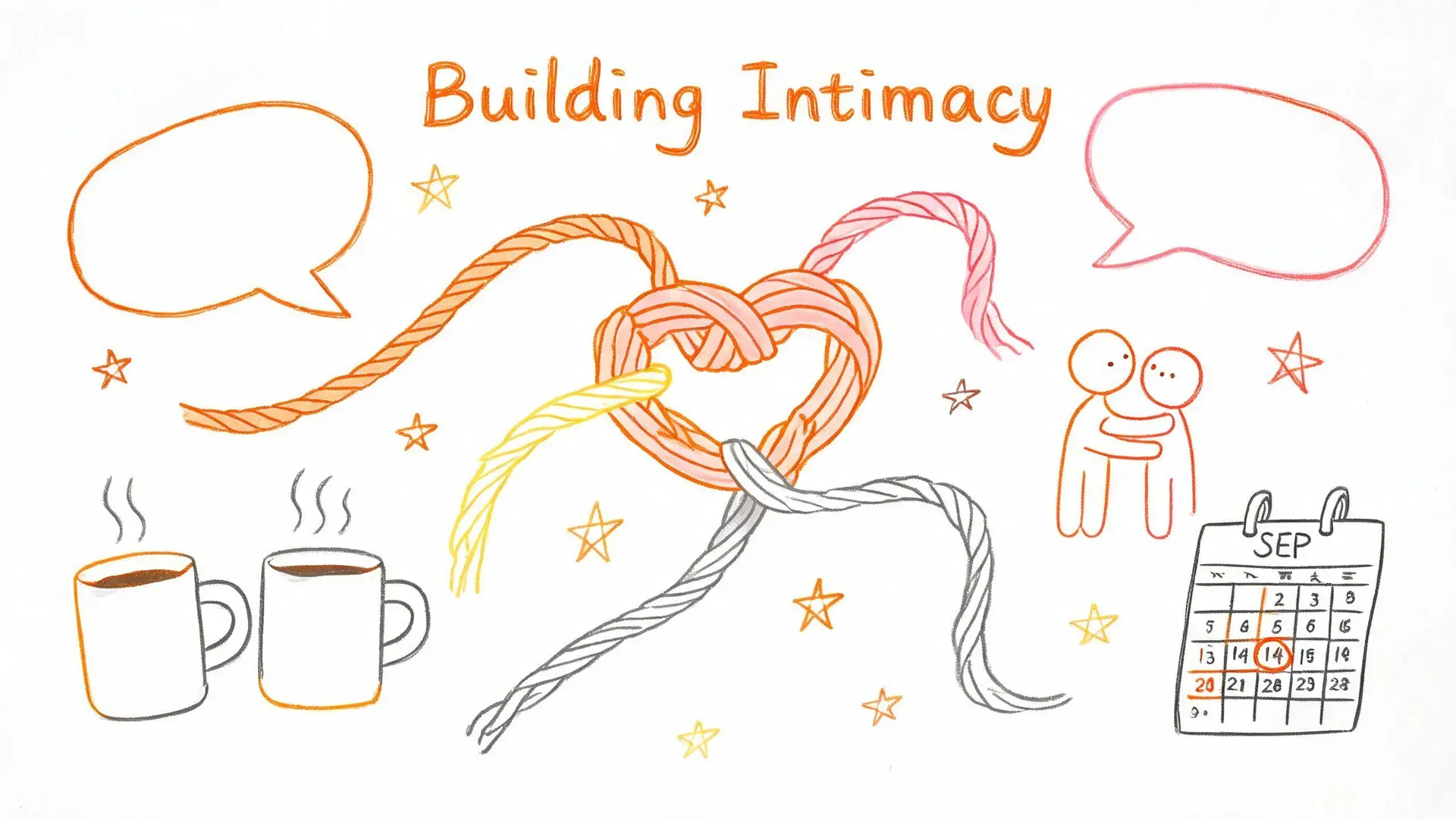
Intimacy in Relationships: How to Build Real Closeness
Couples who stayed married turned toward 86% of their partner's bids for connection; divorcing couples, just 33%. An evidence-based guide to real closeness.
The couples who stay close aren’t the ones who never drift. They’re the ones who keep answering the small moments. In the Gottman Institute’s newlywed research, couples still married six years later had responded to each other’s tiny bids for connection 86% of the time. The couples who divorced? Just 33%.
That’s the uncomfortable truth about intimacy: it rarely dies in one dramatic fight. It fades through a thousand missed micro-moments, and nobody teaches you the mechanics of rebuilding it. “Communicate more” and “schedule date night” are true, but useless without the how.
This guide is the how: how to build intimacy in a relationship that’s gone quiet. What intimacy actually is (hint: four things, not one), why it fades, and the specific, research-backed practices that rebuild closeness. No therapy-speak, no blame, just the evidence and a system you can start this week.
Key Takeaways
- Intimacy runs on four channels (emotional, physical, intellectual, and experiential), and “intimacy = sex” is the most common misdiagnosis. You can starve one channel while feeding another.
- The strongest predictor of lasting relationships isn’t conflict skill: couples still married after six years turned toward 86% of their partner’s bids for connection, versus 33% for couples who divorced (Gottman Institute research).
- Closeness is generatable on demand: in Arthur Aron’s 1997 experiment, structured escalating questions produced real closeness between total strangers in under an hour.
- Sexual frequency predicts well-being only up to about once a week, then plateaus. Physical affection, not sex itself, carries much of the benefit (Muise et al. 2016; Debrot et al. 2017).
- More than half of married couples rarely or never have date nights, so a small weekly rhythm already puts you ahead of most.
What intimacy actually is (it’s not just sex)#
Intimacy is the experience of feeling known, accepted, and close to someone, and it runs on four distinct channels: emotional, physical, intellectual, and experiential.
The field’s foundational framework, the intimacy process model from psychologists Harry Reis and Phillip Shaver, says felt intimacy comes from a specific exchange: one person shares something real, and the other responds with understanding, validation, and care. Laurenceau and colleagues tested this in daily-diary studies ↗ and found exactly that pattern: self-disclosure plus partner responsiveness predicted how close people felt, day by day. Intimacy isn’t a trait a relationship has. It’s a loop two people run, over and over.
That loop can run through four channels:
- Emotional: sharing what you actually feel and want, and being met with responsiveness.
- Physical: touch, affection, and sex. (More on why this is its own channel in a moment.)
- Intellectual: ideas, curiosity, the conversations that make you feel mentally met.
- Experiential: doing things together, especially new things, that become shared history.
The frame matters because it changes the diagnosis. Couples who say “we’ve lost our intimacy” usually mean one channel has gone quiet, often emotional or physical, while others still work fine. You can have great sex and starving emotional intimacy, or deep conversations and no touch. Locating the quiet channel tells you where to start.
And the stakes are bigger than the relationship itself. A landmark 2010 meta-analysis in PLoS Medicine ↗ pooled 148 studies covering more than 308,000 people and found that strong social relationships were associated with a 50% greater likelihood of survival. Closeness isn’t a luxury feature of a good life. It’s closer to a health behavior.
One note on responsiveness, because it’s the engine under everything in this guide: answering a partner’s disclosure with care is the same skill as answering their “no” with respect. If you want to strengthen that muscle, our guide to how consent actually works covers the ongoing-conversation version of it.
Why intimacy fades (and why that’s normal)#
Intimacy erodes through neglect, not catastrophe. Habituation, stress, and screens quietly crowd out the micro-moments closeness runs on. This happens to basically everyone.
Habituation is the big one. Your brain is built to stop noticing what’s constant. The same mechanism that makes a new relationship electric makes a ten-year one invisible: novelty fades, attention drifts, and your partner becomes furniture: beloved furniture, but furniture. Nothing has gone wrong. This is the default setting, not a defect.
Stress and mental load do the next layer of damage. Desire and attention both need spare bandwidth, and a brain triaging deadlines, bills, and logistics doesn’t have much. This is also why fading desire is so often a fading-intimacy symptom rather than a medical problem, a distinction we break down in whether it’s normal to have a low sex drive.
Then there’s the quiet substitution: logistics-talk replaces real talk. “Did you pay the bill?” and “Can you grab milk?” are necessary, but a relationship that runs only on coordination slowly becomes a business partnership. And hovering over all of it: phones. In a 2016 study of 145 adults in relationships ↗, about 46% said their partner regularly “phubbed” them (phone-snubbed them mid-conversation), and about 23% said it caused conflict. A 2025 meta-analysis of the partner-phubbing literature ↗ confirms the pattern: it reliably tracks with lower relationship satisfaction.
The point isn’t that you’re doing it wrong. It’s that intimacy fades by default, for structural reasons, in basically every long relationship. Which is excellent news, because anything that fades by neglect can be rebuilt by practice.
The 86% rule: turn toward bids for connection#
The single strongest predictor of whether a relationship lasts isn’t how well you fight. It’s whether you respond to your partner’s tiny, everyday bids for connection.
A bid is any small attempt to connect: a comment about the weather, a sigh, a hand on your shoulder, “look at that bird.” Your partner makes dozens a day. And each one gets one of three responses. You turn toward it (look up, answer, engage). You turn away (miss it, keep scrolling). Or you turn against (“can’t you see I’m busy?”).
The numbers here are some of the most cited in relationship science. In the Gottman Institute’s newlywed research (130 couples observed in the “Love Lab,” then followed for six years), the couples still married at follow-up had turned toward each other’s bids about 86% of the time. The couples who divorced had managed 33% (Gottman Institute ↗). To be transparent about provenance: these figures come from the Gottman research program as presented by the Institute, not a single journal table. But the underlying finding, that mundane responsiveness predicts survival better than conflict style, has been replicated enough to take seriously.
Why does something so small matter so much? Because bids compound. Every turned-toward moment deposits a little trust: you notice me, I matter to you. And every missed bid makes the next bid less likely. People stop reaching for partners who don’t reach back. The drift couples describe years later (“we just grew apart”) is usually this, one ignored sigh at a time.
The practice is almost embarrassingly simple: notice, then respond. Look up when they speak. Answer the observation about the bird. You don’t need a perfect response: “huh, tell me more” counts. And this is upstream of everything else, including your sex life: disconnection precedes dead bedrooms far more often than the reverse, which is what why couples stop having sex unpacks in full. If starting these conversations feels like the hard part, we’re also building [INTERNAL-LINK: conversation starters for talking about sex with your partner → P2 listicle spoke].
Emotional intimacy: say the real thing#
Emotional closeness is built by escalating, mutual self-disclosure, and it’s so mechanical that researchers can generate it in a lab, on purpose, in under an hour.
In 1997, psychologist Arthur Aron and colleagues published a study with a wonderfully unromantic title: “The Experimental Generation of Interpersonal Closeness.” Pairs of strangers asked each other 36 questions that escalated from mild (“Would you like to be famous?”) to raw (“When did you last cry in front of another person?”). After about 45 minutes, the question pairs reported significantly more closeness than pairs who’d made small talk: closeness comparable, the authors noted, to relationships that usually take weeks or months to form. One pair famously ended up married (Aron et al., 1997 ↗).
Two honest caveats: this was a small lab demonstration of a mechanism, not a recipe for manufacturing love. And the mechanism isn’t the questions: it’s what the questions force. Gradual, mutual, escalating vulnerability. You share something slightly real, they share back, and the floor lowers together.
The other half of the loop is responsiveness. Disclosure only builds closeness when it’s met with understanding, validation, and care: the exact pattern Laurenceau’s daily-diary research confirmed outside the lab. “I had a rough day” met with “that sounds exhausting, what happened?” builds intimacy. The same sentence met with “uh-huh” builds nothing.
Put together, the practice looks like this:
- One real question a week. Not “how was work,” but something with an actual answer. “What’s been taking up space in your head lately?” works fine.
- Appreciation, stated specifically. Not “thanks for everything,” but “I noticed you handled bedtime solo tonight, and it mattered.” Specificity is what makes it land as seeing, not politeness.
- Fifteen minutes of non-logistics talk. The check-in isn’t a meeting. It’s proof that the relationship is more than the shared calendar.
This is also the skill that unlocks the conversations couples dread most. Telling a partner what you actually want is disclosure-plus-responsiveness in its highest-stakes form. We walk through it in how to tell your partner what you want in bed. And if you want a rehearsal with real stakes, talking to a partner about STI testing is the same muscle with training wheels.
Physical intimacy beyond sex#
Affectionate, non-sexual touch (hugging, kissing, hand-holding, an arm across the couch) is intimacy’s daily maintenance dose. And it carries more of the benefit of physical closeness than sex itself does.
Here’s the finding that reframes the whole channel. In a 2017 series of studies published in Personality and Social Psychology Bulletin ↗, Anik Debrot and colleagues found that physical affection largely mediates the link between sexual activity and well-being. Translation: sex predicts happiness mostly because of the affection that comes with it. The cuddling, not just the climax. Affection on its own carried much of the same benefit, which means touch is not foreplay’s supporting act. It’s its own channel.
And about sex frequency, since everyone asks: across three studies totaling more than 30,000 people, Muise, Impett, and Desmarais (2016) ↗ found that sexual frequency predicts greater well-being only up to about once a week. Past that point, more sex didn’t come with more happiness. The pressure to hit some escalating quota is chasing a curve that flattens.
If touch has gone quiet in your relationship, the way back is a ladder, not a leap. Start with touch that expects nothing: a real hug on the way out the door, sitting close enough to touch, a six-second kiss instead of a peck. (The Gottman Institute’s kissing ritual ↗ suggests exactly that: six seconds, long enough to be a moment rather than a reflex. It’s a practice recommendation, not clinical trial data.) Touch rebuilt without pressure reopens the channel; touch that feels like a bill coming due closes it.
One caveat that matters: partners differ in how much touch they want, and that’s normal, not a verdict on the relationship. If one of you wants significantly more physical closeness than the other, in affection or in sex, that’s a desire gap, and it has its own playbook: [INTERNAL-LINK: what a desire discrepancy is and how couples handle it → P2 faq-knowledge spoke]. For the frequency question in full detail, see whether there’s a “normal” amount of sex.
Shared experience: novelty is a closeness machine#
Doing new things together isn’t a nice-to-have. It’s the direct antidote to habituation, and it measurably raises relationship quality in experiments.
The mechanism has a name: self-expansion. Relationships thrive when they keep expanding who you are, and novelty is how that happens. In a 2000 study in the Journal of Personality and Social Psychology ↗, Arthur Aron’s team had couples do activities together: some merely pleasant, some novel and moderately exciting (think obstacle-course silliness, not fine dining). The novel-activity couples reported significantly higher relationship quality afterward. Same time spent, different activity, different outcome. “Be bad at something new together” turns out to be legitimately good advice.
The population-level data points the same direction. In the 2023 Date Night Opportunity report ↗ (a YouGov survey of 2,000 married Americans aged 18–55, from the National Marriage Project and BYU’s Wheatley Institute), 52% of couples said they “never” have date nights or only manage a few a year. The other half did meaningfully better: husbands and wives with regular date nights were 14–15 percentage points more likely to call their marriages “very happy,” and the gap in sexual satisfaction was even wider: 67–68% versus 47%.
Two honest caveats. This is cross-sectional survey data: correlation, not proof; couples who are already happy may simply date more. But it agrees with the experiment-level novelty findings, which is why it’s worth acting on. And a “date night” only counts if it feeds a channel: dinner while both of you scroll is logistics with better lighting. The active ingredients are novelty and conversation, not the restaurant.
Distance changes the tactics but not the principle. Shared novelty over video (cooking the same recipe, playing something together, watching something simultaneously) is still shared experience. We’re building dedicated guides for exactly that: [INTERNAL-LINK: long-distance date ideas that actually build closeness → P2 listicle spoke] and how to keep a long-distance relationship intimate.
Communication: the skill under all the others#
Every intimacy channel runs on communication. Disclosure needs words, bids need answers, and even touch starts with “is this welcome?” The research is blunt about what kills it, and surprisingly hopeful about what repairs it.
The killing part first. The Gottman research program identified four patterns that predict relationship breakdown so reliably they’re called the Four Horsemen: criticism (attacking character instead of behavior), contempt (sarcasm, eye-rolling, mockery; the single worst), defensiveness, and stonewalling (shutting down). Notice these are habits, not personality flaws. Habits can be replaced.
The replacement ratio is the famous one: stable, happy couples run about five positive interactions for every negative one, even during conflict. The Gottman Institute calls this the “magic ratio” ↗. Treat it as a heuristic, not a precise threshold: the point isn’t counting to five, it’s that warmth has to outnumber friction by a wide margin for a relationship to feel safe.
Two more skills do the heavy lifting:
- Repair attempts. Happy couples don’t avoid fights; they recover from them. A mid-argument “wait, I’m being defensive, let me try again” or even a badly timed joke is a repair attempt, and whether it lands predicts outcomes better than whether the fight happened.
- The soft start-up. Raise hard topics with the formula “I feel ___ about ___; I need ___.” Compare “You never plan anything for us” (criticism, guarantees defensiveness) with “I miss doing things just for us; I’d love a real date this month” (same issue, four times the odds of a useful conversation).
And boundaries belong in this section, not in a section about distance. A clearly stated limit (“I need an hour alone after work before I can really talk”) is information that lets your partner stop guessing. Couples who can say no safely can say yes freely. More on that in [INTERNAL-LINK: how to set boundaries without hurting your partner → P2 how-to spoke]. When communication has already broken badly, after a betrayal, for instance, the rebuild follows a different map: how to rebuild trust after a betrayal.
Communication is also where this pillar shakes hands with the rest of the site. Talking about testing, protection, and health is the same skill pointed at a different topic: our complete guide to sexual health covers that side, and the sex ed most adults never got fills in the foundation underneath it.
Staying connected: a weekly operating system#
Closeness survives on structure, not willpower. Everything in this guide compresses into a weekly rhythm small enough to actually run.
Here’s the minimum viable version:
- Daily (2 minutes total): answer bids. Look up when they speak. One six-second kiss. That’s it.
- Weekly (15–20 minutes): one real question, traded both ways, plus one specific appreciation each. Phones in another room. Remember what phubbing costs.
- Once or twice a month: one shared experience with novelty in it. New trail, new recipe, new board game, new anything. Remember: 52% of married couples never do this. One or two a month already puts you ahead of the majority.
And for the times you’ve already drifted, because most people reading this aren’t starting from zero:
- Name it without blame. “I miss us” opens a conversation. “You’ve checked out” opens a trial.
- Start smaller than feels meaningful. Two weeks of answered bids do more than one big talk.
- Expect awkward. The first check-in will feel staged. That’s not failure; that’s what restarting feels like.
One more thing, and it deserves its own sentence: sometimes the right move is a couples therapist. Persistent contempt, betrayal trauma, or a desire gap that turns every attempt into a fight are patterns a blog post can’t fix, and therapy for them is normal maintenance, not defeat. Plenty of couples go before things fall apart, and going early is exactly what makes it work.
The guides going deeper on each piece of this system are coming: start with keeping intimacy alive across distance, then telling your partner what you want in bed, why couples stop having sex and how to reconnect, [INTERNAL-LINK: how often couples actually have sex, per the data → P2 data-research spoke], and the rest of the intimacy cluster. Start with whichever section made you think “that’s us.”
Frequently asked questions#
What are the four types of intimacy?#
Emotional (sharing real feelings and being met with care), physical (touch and affection, not just sex), intellectual (ideas and curiosity), and experiential (doing things together). Each feeds closeness independently, so “we’ve lost our intimacy” usually means one channel has gone quiet. That’s where to start.
Can a relationship survive without intimacy?#
It can survive, but it starves. The Gottman bids research suggests disconnection compounds: missed bids lead to fewer bids, and “we grew apart” becomes the story. The good news is the same loop runs in reverse: small, consistent responses rebuild closeness faster than most people expect.
How often should couples have sex?#
There’s no quota that predicts happiness. Across three studies with more than 30,000 people, Muise and colleagues (2016) found well-being rises with frequency only up to about once a week, then plateaus. Quality of connection beats counting. The full data is in whether there’s a “normal” amount of sex.
Is intimacy the same as sex?#
No, and the difference matters. Debrot and colleagues (2017) found that physical affection largely mediates the link between sex and well-being: the closeness, not the act, carries much of the benefit. Non-sexual touch delivers a real share of that on its own.
How do you rebuild intimacy after drifting apart?#
Name it without blame (“I miss us,” not “you’ve changed”), restart small (answered bids, brief touch, one real question a week) and expect the first attempts to feel awkward. Awkward is what restarting feels like. If the drift involves betrayal or contempt, that’s couples-therapy territory, and going is normal.
Do date nights actually work?#
The 2023 Date Night Opportunity survey found couples with regular date nights were 14–15 percentage points more likely to call their marriages “very happy,” but that’s correlational, and happier couples may simply date more. The experiment-level evidence (Aron’s novelty studies) is stronger: new shared activities measurably raise relationship quality. A date only counts if it includes novelty or real conversation.
Key takeaways#
Intimacy is four channels, not one, and “intimacy = sex” is the most common misdiagnosis. It fades by default, through habituation and neglect, which means it rebuilds by practice: turn toward bids (the 86% habit), trade real disclosure, touch without agenda, do new things together, and protect a small weekly rhythm. When the pattern is contempt, betrayal, or a desire gap that fights back, a couples therapist is a tool, not a verdict.
You don’t need the whole system today. Pick the channel that’s gone quietest and start there: one answered bid, one real question, one novel evening. Closeness is a habit, not a honeymoon.
This article is for general education and isn’t a substitute for working with a qualified couples therapist or counselor. If your relationship involves persistent contempt, betrayal, or fear, professional support is the right next step, not a blog post.