Sex Ed You Missed: How Consent Actually Works
Consent is more than a single yes. Here's how consent actually works — the 5 elements, why "no means no" falls short, and what 33% of men still get wrong.
Here’s a number worth sitting with. In a 2025 survey, a third of men under 45 (that’s 33%) said they’d probably keep going even if they suspected a partner wasn’t enjoying a sexual encounter. Now hold that next to a second number from the same research: 93% of adults said they personally understand consent.
Both are true. That’s the problem.
Most of us were taught some version of “no means no.” It was a start, but it was a floor, not a ceiling, and it quietly put the burden on the person refusing rather than the person initiating. The model has since moved on, and the data suggests a lot of people haven’t moved with it. What follows is what consent actually is, how it works in practice, and where it most often breaks down, including in relationships where everyone assumes it’s already handled.
Key Takeaways
- Consent is ongoing, reversible, and enthusiastic, not a one-time yes. Modern models organize it around five elements: Freely given, Reversible, Informed, Enthusiastic, Specific.
- “No means no” was the floor, not the ceiling. The shift to “yes means yes” moves responsibility to the initiator and covers the people who freeze or can’t speak.
- The biggest risk is overconfidence. In a 2025 Dublin survey, 93% of adults said they understand consent, yet 33% of men under 45 said they’d keep going if a partner seemed disengaged (Dublin Rape Crisis Centre ↗, 2025).
- Long-term relationships don’t retire the requirement. Familiarity relaxes the formality, not the need; even established couples misread each other.
Why “no means no” was never enough#
“No means no” did real work. It named a boundary and gave people language for it. The problem is what it assumes: that consent is the absence of refusal, and that everyone in every situation is able to refuse clearly, out loud, in the moment.
That assumption fails in two common scenarios. The first is incapacitation. In Cornell’s 2025 Survey of Sexual Assault and Related Misconduct, half of those who experienced nonconsensual contact (50%) reported being incapacitated at the time, with alcohol involved in over half of cases (Cornell University ↗, 2025). A person who is incapacitated can’t say no. A model that waits for a “no” has nothing to say about them.
The second scenario is quieter. Plenty of people freeze. Faced with something unwanted, they go still, go blank, go along. Not because they agree, but because their nervous system has chosen the option that feels safest. Silence and stillness aren’t refusal, but they aren’t consent either. “No means no” can’t tell the difference, because it was never listening for a yes.
That gap is exactly what the newer model was built to close. Consent isn’t the absence of a no; it’s the presence of a yes, and the responsibility for finding it sits with the person initiating, not the person being asked. If you’ve absorbed the broader pattern of sex myths worth unlearning, this one sits near the top of the list.
The 5 elements of real consent#
Strip away the legal jargon and the campus-policy phrasing, and modern consent models converge on five elements. Planned Parenthood organizes them under the acronym FRIES (Planned Parenthood ↗). Each one is simple on its own; together they’re the whole picture.
- Freely given. Agreement without pressure, guilt, manipulation, or force. A yes extracted by wearing someone down isn’t freely given. It’s surrendered.
- Reversible. Anyone can change their mind at any point, including partway through. A yes isn’t a contract; it expires the moment someone wants it to.
- Informed. You can only agree to what you actually know about. Being honest about what you’re proposing, and about things like STI status or other partners, is part of the agreement.
- Enthusiastic. The standard isn’t the absence of reluctance; it’s the presence of genuine willingness. “I guess,” “fine,” and a resigned shrug are not enthusiasm.
- Specific. Saying yes to one thing is not saying yes to everything. Agreeing to kiss isn’t agreeing to more; agreeing tonight isn’t agreeing forever.
Two of these carry most of the real-world weight. Reversible is the one people forget in the moment: consent can be withdrawn at any time, and when it is, activity stops, without negotiation. Specific is the one people forget across encounters: each new act is its own question, not a footnote to an earlier yes.
Affirmative vs. enthusiastic consent#
These two phrases get used interchangeably, and they’re not the same thing. The distinction matters.
Affirmative consent is the policy and legal standard: an active, explicit yes. It’s the “yes means yes” model written into university conduct codes and some state laws. Its concern is whether agreement was expressed: clearly, outwardly, by all parties.
Enthusiastic consent is about the quality of that yes. It asks not just “did they agree?” but “do they actually want this?” It treats a hesitant, ambivalent, or coerced-by-context yes as falling short even if it technically counts.
Here’s an honest complication, because the topic deserves it. “Enthusiastic” can be an unrealistically high bar. Real desire is sometimes quiet, nervous, or low-key, especially for people who are shy, anxious, or new to something. Insisting on visible eagerness risks pathologizing genuine but understated willingness. That’s a fair criticism, and it’s why the load-bearing core of consent isn’t enthusiasm itself. It’s the other four elements: freely given, reversible, informed, specific. Enthusiasm is the spirit; the rest is the structure.
The broader confusion is measurable. In the 2025 Dublin research, 93% of adults said they understand consent, but believed only 62% of other people do (Dublin Rape Crisis Centre ↗, 2025). Nearly everyone thinks they’ve got it and everyone else doesn’t. That can’t be right, and the next numbers show it isn’t.
What consent looks like in practice#
So what does a “yes” actually look like? In principle it’s simple: someone communicates, clearly and freely, that they want this. In practice, people communicate it in a few different ways, and they’re not equally reliable.
The clearest is verbal. “Is this okay?” “Do you want to keep going?” “Tell me what you like.” Asking out loud feels awkward to some people, as if it breaks a mood. It doesn’t. A partner who wants you will not be put off by finding out, and a partner who doesn’t want this is exactly the one you needed to ask.
Then there’s nonverbal: reciprocating a move, pulling someone closer, actively participating. These signals are real, and in an established rhythm they carry meaning. But they’re also the easiest to misread, because they require one person to interpret another’s body, and interpretation is where bias, hope, and assumption creep in.
How people actually do this leans heavily on the less reliable channel. In research by Kristen Jozkowski and colleagues on how people communicated consent in their most recent encounter, 85% reported using nonverbal cues like touching or undressing, 68% communicated by simply not resisting, and far fewer used explicit verbal agreement (Jozkowski et al., Journal of Sex Research ↗, 2014). In other words, most consent is inferred from body language and the absence of a “no,” the two channels most prone to misreading.
That’s not an argument that nonverbal consent is fake. It’s an argument that the more ambiguous the channel, the more a quick check-in earns its keep. “Still good?” costs three seconds and settles what body language leaves open.
Where consent breaks down#
Most consent failures aren’t cartoon villainy. They’re misreading: one person treating an ambiguous signal as a green light, or treating a “no” as the start of a negotiation rather than the end of a question.
The clearest example is the idea that “no” sometimes means “convince me.” In the 2025 Dublin research, 43% of men under 45 (rising to 54% of men aged 18 to 24) endorsed that belief (Dublin Rape Crisis Centre ↗, 2025). A 2022 study of 716 college students in the Journal of Sex Research found that men reported they’d believe a woman’s refusal only after an average of 2.6 “no”s, and that sexual arousal made both men and women more likely to treat “no” as “convince me” (Rerick et al., 2022 ↗). Treat the first “no” as the answer and the 2.6 never comes up.
There’s a subtler failure underneath, and it’s the one researchers find most useful. Consent isn’t one thing. It’s two. Internal consent is what a person actually feels: willingness, desire, comfort. External consent is what they communicate. The two don’t always match. Someone can feel unwilling and stay silent, or feel willing and signal it badly. This is the same body-mind gap that shows up as arousal non-concordance, where a physical response says nothing reliable about what’s wanted. When consent lives only in the external channel, read off someone’s body, never confirmed, the internal reality can be completely different and no one would know.
That’s the gray zone where things go wrong. Not “did they technically not object,” but “did I ever actually find out what they wanted.” The fix is unglamorous: when the signal is ambiguous, ask. When it’s silent, ask. When you can’t tell, that’s your answer. Ask, or stop.
Does consent still matter in long-term relationships?#
Yes. This is the objection that comes up most, so it’s worth meeting directly: we’ve been together for years, do we really need to keep checking?
The honest answer is that the formality relaxes but the requirement doesn’t. Established couples develop shorthand, a look, a rhythm, a shared history, and that’s real. But familiarity breeds assumption, and assumption is the exact failure mode from the last section. Knowing someone well makes it easier to think you can read them, not easier to actually be right.
And the pressure to go along doesn’t vanish with commitment. In a 2025 study of young autistic adults by Dublin Rape Crisis Centre and AsIAm, 65% had continued unwanted sexual activity out of guilt or a sense of obligation, even though 90% understood consent could be withdrawn at any time (DRCC / AsIAm ↗, 2025). Knowing you can stop and feeling able to are different things, and the gap is widest in relationships where disappointing a partner carries a cost. Obligation is not consent, no matter how long you’ve been together.
The reframe that helps: in a long-term relationship, consent stops being a series of formal questions and becomes an ongoing conversation about desire itself, including whether there’s a “normal” amount of sex and what each of you actually wants. The couples who do this well aren’t checking boxes; they’re staying curious about a person who keeps changing.
Consent is a practice, not a permission slip#
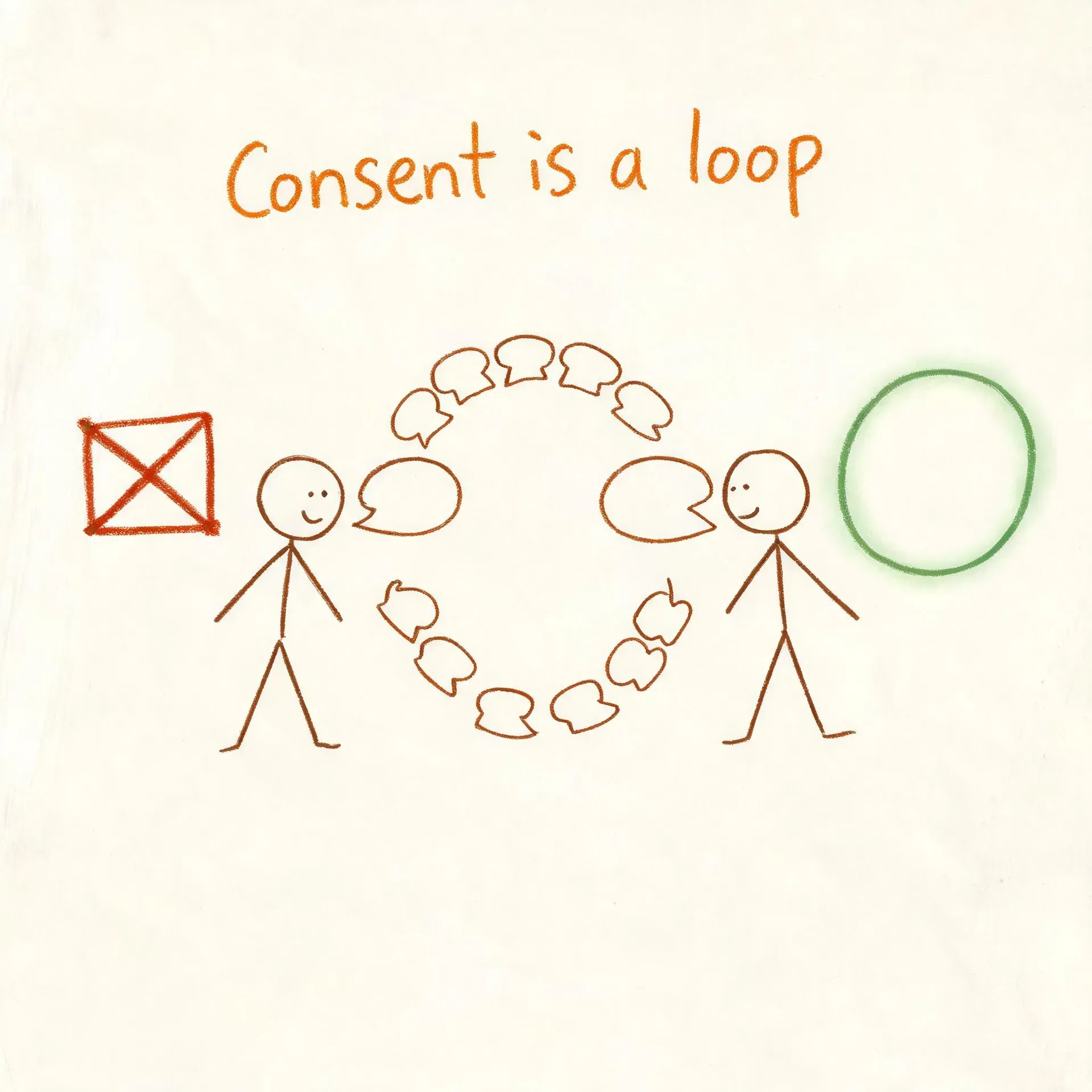
Pull the threads together and a single idea holds them. Consent isn’t a question you answer once at the door. It’s a dialogue you maintain: freely given, reversible, informed, enthusiastic, specific, and renewed as things change.
That framing shifts the weight off the moments everyone dreads. There’s no single high-stakes conversation to get right; there’s a low-stakes habit of staying tuned in. The people who are genuinely good at this aren’t the ones who memorized a definition. They’re the ones who kept asking.
And the appetite for that is real. Nearly half the population (47%) wants to learn more about consent (Dublin Rape Crisis Centre ↗, 2025). Which brings it back to where we started: almost everyone thinks they already understand it, and a third of men hold a belief that flatly contradicts it. The gap between those two facts isn’t closed by information alone. It’s closed by practice. If this reframed something, the complete guide to sex education for adults carries the same idea across the rest of the topic, including a few masturbation myths built on the same shaky assumptions.
Frequently asked questions#
What are the 5 elements of consent?#
Freely given, Reversible, Informed, Enthusiastic, and Specific: the FRIES framework from Planned Parenthood. Consent must be given without pressure, can be withdrawn at any time, requires honest information, reflects genuine willingness rather than reluctance, and applies to each act individually rather than as blanket permission.
Can you take back consent after saying yes?#
Yes, at any time, including partway through. “Reversible” is one of the five core elements. The moment someone withdraws consent, activity stops, without argument or negotiation. A yes is never a contract.
What’s the difference between affirmative and enthusiastic consent?#
Affirmative consent is the explicit, active “yes,” the legal and policy standard concerned with whether agreement was expressed. Enthusiastic consent is about the quality of that yes: wanted, not just permitted. They’re related but distinct. One is about the presence of agreement, the other about its genuineness.
Does body language count as consent?#
Nonverbal cues are common (most people use them), but they’re the channel most prone to misreading, because they require one person to interpret another’s body. Research by Jozkowski and colleagues (2014) found 85% of people relied on nonverbal cues in their last encounter while far fewer used explicit verbal agreement. Body language can communicate consent, but explicit confirmation is the reliable standard, especially with a new partner.
How does consent work in an ongoing relationship?#
It shifts from a series of formal questions to an ongoing conversation about desire. The formality relaxes, but the requirement doesn’t. Established partners still misread each other, and familiarity breeds assumption, so the practice becomes staying curious and checking in rather than checking a box once.
The bottom line#
- Consent is ongoing, reversible, and enthusiastic: a continuous dialogue, not a one-time permission slip.
- “No means no” was the floor. “Yes means yes” moves the responsibility to the initiator and covers the people who can’t refuse.
- The biggest risk is overconfidence. Most people think they understand consent; a third of men under 45 hold a belief that contradicts it.
- Long-term relationships don’t retire the requirement. Familiarity relaxes the formality, not the need, and obligation is not consent.
If one idea is worth carrying out, it’s the simplest one: when you’re not sure, ask. It costs a few seconds, it never ruins anything worth having, and it’s the whole practice in a single habit.