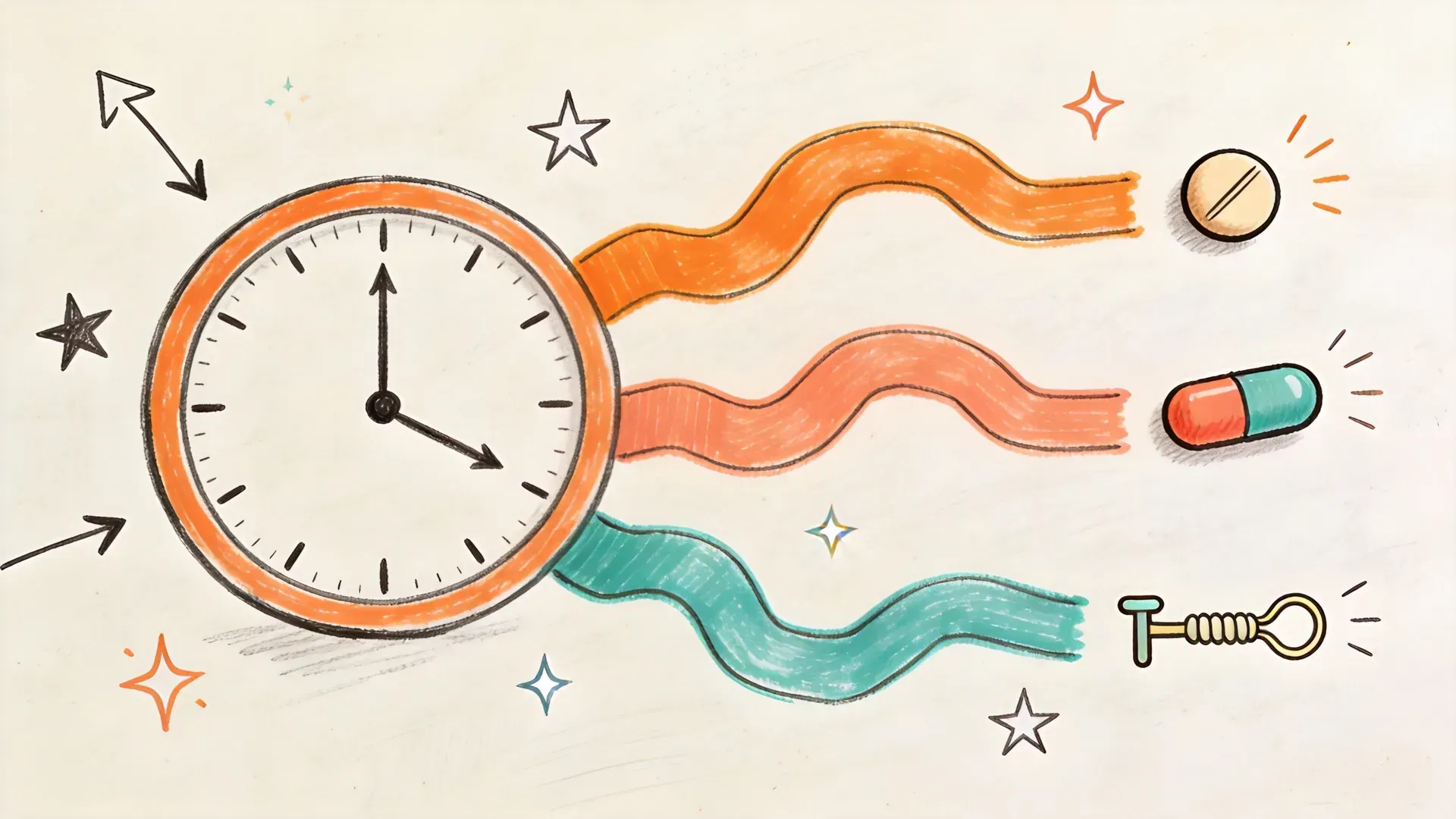
Emergency Contraception: How It Works and When to Use It
Emergency contraception can prevent up to 95% of pregnancies — best within 24 hours, effective out to 5 days. How Plan B, ella, and the copper IUD compare.
The condom broke. Or you missed two pills. Or things just happened faster than the planning did. However you got here, the question is the same: what can you still do, and how much time do you have?
More than you might think. Emergency contraception can prevent up to 95% of pregnancies, most when it’s used in the first 24 hours, with declining but real effectiveness out to 5 days, according to the World Health Organization ↗. But the window isn’t uniform, the options aren’t interchangeable, and the most effective one is the one almost nobody mentions.
This guide walks through how each option actually works, how effective it is, and how to pick the right one for your situation. (This is education, not personal medical advice. A pharmacist or clinician can answer questions about your specific case.)
Key Takeaways
- Emergency contraception prevents pregnancy. It doesn’t end one. The pills work by delaying ovulation; the copper IUD blocks fertilization. Neither can interrupt an established pregnancy (WHO ↗).
- You have three options. Levonorgestrel pills (Plan B and generics, over the counter), ulipristal acetate (ella, prescription), and the copper IUD, which is more than 99% effective and doubles as years of ongoing birth control.
- Sooner beats later. Levonorgestrel works best in the first 72 hours; ulipristal holds its effectiveness out to the full 120 hours.
- Body weight matters for the pills. They’re less effective at a BMI over 30. The copper IUD’s effectiveness doesn’t depend on weight at all.
How emergency contraception actually works (and what it doesn’t do)#
Emergency contraception stops a pregnancy from starting. It can’t stop one that’s already begun. That’s the single most misunderstood thing about it, so let’s be precise.
Pregnancy isn’t an event; it’s a sequence. Sex deposits sperm, which can survive in the reproductive tract for up to five days. Ovulation releases an egg. If sperm meets egg, fertilization happens. The fertilized egg then travels and implants, a process that takes days. Emergency contraception interrupts the early steps of that sequence.
The pills (both levonorgestrel and ulipristal acetate) work mainly by delaying ovulation. They hit pause on the hormone surge that releases an egg, so there’s no egg waiting when the sperm arrive. No egg, no fertilization, no pregnancy.
The copper IUD works differently. Copper ions are toxic to sperm, so it blocks fertilization directly. Inserted after unprotected sex, it prevents fertilization from happening at all.
Here’s the implication that matters: if you’ve already ovulated, the pills probably won’t help you, because there’s nothing left to delay. The WHO is unambiguous on the bigger point: emergency contraception “cannot interrupt an established pregnancy or harm a developing embryo.” It is not the abortion pill, it doesn’t work like the abortion pill, and taking it can’t hurt a pregnancy that’s already underway.
If you’re fuzzy on when pregnancy is even possible in your cycle, our guide on when you can actually get pregnant covers the timing side.
The three options: Plan B, ella, and the copper IUD#
You have three real options, and they differ in window, effectiveness, and how you get them.
Levonorgestrel pills (Plan B One-Step and generics). A single 1.5 mg dose, sold over the counter in the US to anyone of any age: no ID, no prescription. Generics sit on the same shelf and work identically for less money. Pregnancy rate after use: 1.2% to 2.1% (WHO ↗).
Ulipristal acetate (ella). A single 30 mg dose that needs a prescription in the US (many telehealth services can send one to a pharmacy same-day). Pregnancy rate: 1.2%, and it holds up better in the later part of the window, as you’ll see below.
The copper IUD (Paragard). A small device a clinician inserts into the uterus. It’s more than 99% effective as emergency contraception when placed within 5 days, and the WHO calls it “the most effective form of emergency contraception available.” The bonus: it then keeps working as birth control for a decade or more. The catch: you need an appointment, fast.
| Levonorgestrel (Plan B) | Ulipristal (ella) | Copper IUD | |
|---|---|---|---|
| Window | Best within 72h | Full 120h | Full 120h |
| Pregnancy rate | 1.2–2.1% | 1.2% | Under 1% |
| How you get it | Pharmacy shelf, no Rx | Prescription | Clinic visit |
| Rough US cost | $10–50 | $40–50 + visit | $0–1,000, usually covered |
| Keeps working after? | No | No | Yes, 10+ years |
One more access note: under the Affordable Care Act, most US insurance plans cover FDA-approved emergency contraception at no cost, and family planning clinics often offer it free or cheap (Office on Women’s Health ↗). Brand-name Plan B runs about $40–50 at the pharmacy counter; generics cost noticeably less (Planned Parenthood ↗).
Timing: why sooner beats later#
All three options work up to 5 days after unprotected sex. But “works within 5 days” hides a steep drop-off, at least for levonorgestrel.
In the classic WHO trials, levonorgestrel prevented about 95% of expected pregnancies when taken within 24 hours, roughly 85% at 25–48 hours, and about 58% at 49–72 hours. Beyond 72 hours it keeps declining and the data gets thin. That’s why the “morning-after” nickname is half right: morning after is genuinely better than three days later.
Ulipristal tells a different story. In the head-to-head Lancet trial (2,221 women), it stayed consistently effective across the full 120-hour window: pregnancy rates of 1.6% for ulipristal versus 2.6% for levonorgestrel within 5 days (Glasier et al., The Lancet ↗, 2010). The WHO notes ulipristal is the more effective pill specifically in that 72–120 hour stretch.
The copper IUD doesn’t decay at all: same 99%+ effectiveness on day five as on day one.
The practical takeaway: take whatever you can get as soon as you can get it. Don’t wait for the “better” option while the clock runs. But if you’re already on day three or four, ulipristal or the IUD is worth the extra effort.
Does body weight change how well it works?#
Yes for the pills, no for the IUD. This is one of the most useful things to know before you choose.
The evidence suggests levonorgestrel pills are less effective at a BMI over 30 (and possibly starting around 25–26). Ulipristal may lose some effectiveness at higher weights too, though the drop-off looks smaller. The WHO’s summary: the pills were “found to be less effective in obese women (whose body mass index is more than 30 kg/m²), but there are no safety concerns.”
Read that last part again. Less effective doesn’t mean unsafe, and it doesn’t mean pointless. A reduced-chance pill still beats no pill. But if your BMI is over 30, the smarter move is asking a pharmacist or clinician about ulipristal, or going straight to the copper IUD, whose effectiveness doesn’t depend on body weight at all.
Which one should you use? A quick decision guide#
Match the option to your situation:
- It’s been under 72 hours and you want the simplest path → levonorgestrel from any pharmacy shelf. Fast, cheap, no appointment.
- It’s been 3–5 days → ulipristal (prescription, often same-day via telehealth) or a copper IUD. Levonorgestrel’s effectiveness has dropped sharply by then.
- Your BMI is over 30 → skip straight to the ulipristal-or-IUD conversation.
- You want this problem solved for years, not days → the copper IUD. Most effective now, keeps protecting you for a decade.
- You think you may have already ovulated → the pills work by delaying ovulation, so a copper IUD is the more reliable choice if you can get one placed in time.
- You can’t swallow pills or vomit within 2 hours of taking one → repeat the dose (per WHO guidance), or consider the IUD.
And one rule that overrides everything else: any option in hand now beats a theoretically better option tomorrow. Effectiveness is highest on day one, whichever method you use.
Common mistakes to avoid#
Waiting to “see what happens.” There’s nothing to wait for: levonorgestrel sheds effectiveness every day you delay. The whole point of the timing data above is that day one beats day three by a wide margin.
Not repeating the dose after vomiting. If you throw up within 2 hours of taking a pill, the WHO says to take it again. Your body likely didn’t absorb the dose. Past the 2-hour mark, you’re fine.
Stacking both pills “for extra protection.” Don’t. Levonorgestrel and ulipristal both act on progesterone receptors, and taking them in the same episode can blunt ulipristal’s effect (AAFP ↗). Pick one pill, or go with the IUD.
Using it as your regular method. Emergency contraception is safe to use repeatedly, but every routine method beats it on effectiveness. If it’s your third time this year, that’s a planning problem, not an emergency problem.
Safety, side effects, and the myths worth dropping#
Emergency contraception has one of the cleanest safety records in medicine. A Cochrane review of 115 randomized trials covering more than 60,000 women found no serious adverse effects in any of them (via AAFP ↗, 2020). The WHO adds that there are no absolute medical contraindications and no age limits for the pills.
What you might actually notice:
- Nausea is the most common side effect, usually mild and gone within a day or two.
- A shifted next period. It may come earlier or later than expected. Ulipristal delays the next period a bit more often than levonorgestrel.
- Spotting, breast tenderness, a headache. All temporary.
Now the myths:
- “It’s the abortion pill.” No. It prevents ovulation or fertilization. It cannot end an established pregnancy. Different mechanism, different drugs, different situation entirely.
- “It’ll mess up my fertility.” No. The WHO states plainly that emergency contraception drugs “do not harm future fertility.”
- “You can only take it once or twice in your life.” There’s no medical limit. It’s safe to use more than once. But it’s less effective than any regular method, so needing it repeatedly is your cue to choose a birth control method that fits your life instead.
After you take it: what happens next#
You’ve taken the pill (or gotten the IUD). Here’s what the next few weeks look like.
Your period may be weird once. Earlier, later, heavier, or lighter: all normal. If it’s more than about 7 days late, take a pregnancy test. No method is 100%, and that’s the check that tells you where you stand.
Restart your regular contraception carefully. After levonorgestrel, you can resume hormonal birth control right away. After ulipristal, wait. The WHO advises starting progestogen-containing contraception on day 6, because starting sooner can blunt ulipristal’s effect. Use condoms in the gap.
Think about STIs, because emergency contraception doesn’t touch them. It prevents pregnancy, full stop. If the unprotected sex carried any STI risk, that’s a separate box to tick. Our guide on what happens at a sexual health checkup walks through exactly what to expect. And here’s how to bring up testing with a partner without it getting awkward.
Know you’re in big company. Lifetime use has been doubling in the CDC’s tracking: 10.8% of women who’d ever had sex had used emergency contraception in 2006–2010, rising to 20.0% by 2011–2015 (CDC National Survey of Family Growth ↗). And in 2022–2023 alone, 3.7% of US females aged 15–49 received emergency contraception within a single year (CDC NCHS Data Brief 520 ↗). This isn’t a fringe move. It’s a normal part of modern reproductive life.
Frequently asked questions#
Is emergency contraception the same as the abortion pill?#
No. Emergency contraception prevents pregnancy by delaying ovulation or blocking fertilization; it can’t end an established pregnancy, per the WHO ↗. Medication abortion (mifepristone and misoprostol) is a different regimen for a different situation.
Can I use emergency contraception more than once?#
Yes. There’s no medical cap on how many times you can take it, and no evidence of harm from repeated use. It just wasn’t designed as a routine method: every regular contraceptive beats it on effectiveness. If it’s becoming a habit, that’s a sign to sort out a primary method.
Does Plan B work if I’ve already ovulated?#
Probably not. The pills work by delaying ovulation, so once an egg is out, there’s nothing for them to pause. If you suspect you’ve ovulated (say, you track your cycle and you’re mid-fertile-window), the copper IUD is the reliable option, because it works by disabling sperm instead.
Will emergency contraception affect my future fertility?#
No. The WHO is explicit: the drugs used for emergency contraception don’t harm future fertility. Your cycle returns to normal quickly, usually by the very next period.
Do I need a prescription?#
Depends on the option. Levonorgestrel pills (Plan B and generics): no. Over the counter, any age, no ID in the US. Ulipristal (ella): yes, a prescription, though telehealth can often get one to your pharmacy the same day. Copper IUD: a clinic visit for insertion. Most insurance plans cover FDA-approved emergency contraception at no cost (Office on Women’s Health ↗).
The bottom line#
Emergency contraception is a safety net with a clock on it:
- It prevents pregnancy; it doesn’t end one. Pills delay ovulation, the copper IUD blocks fertilization.
- Sooner is always better. Levonorgestrel fades from ~95% to ~58% across its first 72 hours, while ulipristal and the IUD hold out to day five.
- The copper IUD is the most effective option by a wide margin, and it keeps working for years.
- It’s safe and remarkably common. No serious adverse effects across 115 trials, and more than 1 in 4 US women have used it.
If you took it once, you’re done. Watch for your period and move on. If this is becoming a pattern, the kinder long-term fix is a method that works before the emergency. Start with our guide on how to choose a birth control method that fits your life, or see how condoms and the pill compare if you’re weighing the two most common ones. And for the bigger picture, the complete sexual health guide ties it all together.