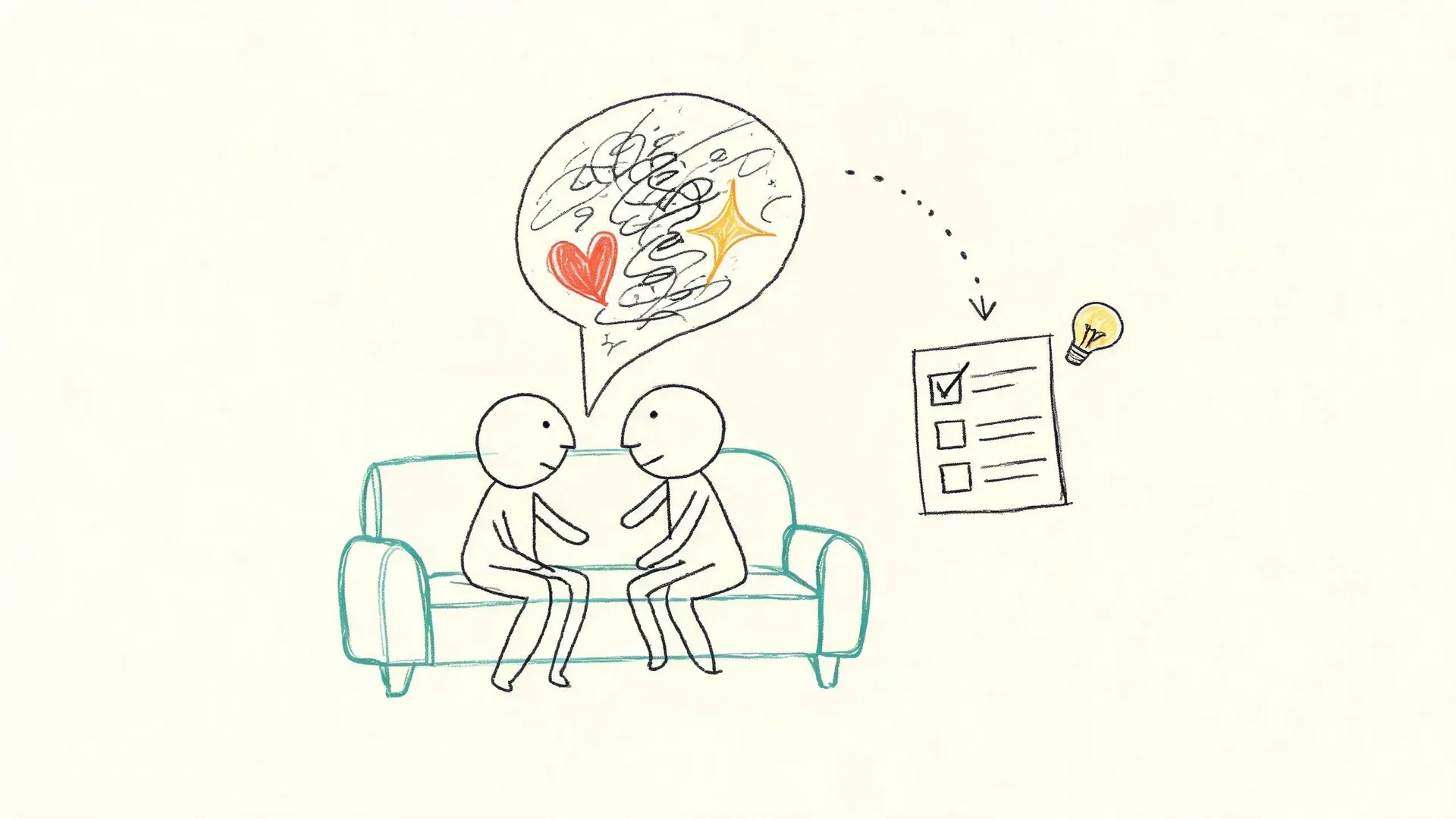
How to Tell Your Partner What You Want in Bed
2 in 5 people find it too awkward to talk about sex with a partner. Five scripts you can adapt, the research on timing, and a repair plan if it goes badly.
Ask couples what they argue about and you’ll hear money, chores, whose family gets the holidays. Ask what they never talk about at all, and the answers converge on one subject.
Two in five people say it’s too awkward to tell their partner what they want in bed (Paired, 2021 ↗). That silence has a cost. Unspoken preferences don’t evaporate; they turn into routines nobody enjoys and orgasms faked to end a scene politely. In a 2024 survey of 2,220 women published in Frontiers in Psychology, 47.3% reported having faked an orgasm during intercourse, and 33.9% during oral sex (Csányi et al., 2024 ↗).
The couples who don’t have this problem aren’t more experienced or more adventurous. They’ve just made the conversation routine. This guide covers how to tell your partner what you want in bed: what the research shows about why speaking up works, when to do it, five scripts you can adapt word for word, and what to do if the first attempt goes sideways.
Key Takeaways
- Talking about sex is one of the most consistent correlates of satisfaction researchers have found. Across 93 studies and 38,499 people, sexual communication correlated with sexual satisfaction at r = .43, and how couples talk mattered more than how often: quality of sexual communication correlated at r = .52 (Mallory, 2022 ↗, Journal of Family Psychology).
- Most people are carrying something they’ve never said. About 4 in 5 want to act on their biggest sexual fantasy; only about half have ever told a partner, and roughly 1 in 5 have acted on it (Lehmiller, 2019 ↗).
- Timing does measurable work. Post-sex affection predicted sexual and relationship satisfaction more strongly than the duration of foreplay or intercourse, and the effect held three months later (Muise et al., 2014 ↗).
- Defensiveness is a first reaction, not a verdict. Fear of a partner’s reaction is one of the most common reasons couples avoid this conversation entirely, so plan the repair before you need it.
Why talking about sex feels so hard, and why it pays#
The awkwardness is close to universal, and the payoff is one of the most replicated findings in relationship science. Start with the awkwardness. In a survey of 4,000 adults in the US and UK, 40% said they found it too awkward to talk to their partner about sex, and 24% named embarrassment as the single biggest barrier (Paired, 2021 ↗). An in-house survey by the relationship-advice site Marriage.com found something similar in shape: 33.8% of 2,399 American adults in committed relationships actively avoid conversations about sex and physical intimacy, and the reasons cluster tightly around self-protection. Difficulty putting feelings into words, 30%. Fear of a partner’s reaction, 29.8%. Worry that the conversation itself could harm the relationship, 29.2%. Fear of rejection or judgment, 16.6% (Marriage.com, 2025 ↗, sponsored survey fielded August 2025, ±2% margin of error).
Notice what those numbers have in common: nobody is avoiding sex talk because they don’t care. They’re avoiding it because they’re afraid of what it might cost. Which is why the research on what that conversation buys is worth reading closely.
The strongest evidence comes from a meta-analysis of 93 studies covering 38,499 people, published in the Journal of Family Psychology. Sexual communication correlated with sexual satisfaction at r = .43, and with relationship satisfaction at r = .37 (Mallory, 2022 ↗), on a scale where 1.0 is a perfect match and 0 means no relationship at all. In behavioral-science terms those are substantial associations, not statistical noise.
The most useful detail in that study is the gap between the top and bottom bars. Frequency of sexual communication correlated with sexual satisfaction at r = .31; the quality of that communication correlated at r = .52. Talking about sex constantly, badly, is not the goal. Talking about it well, occasionally, is what moves the needle.
That’s a low bar to clear, and it reframes what you’re being asked to do. You don’t need to become a couple who discusses technique over breakfast. You need one honest, kind conversation, and then a habit of having them.
Before you tell your partner what you want in bed#
Most people walk into this conversation carrying a vague sense of dissatisfaction, then discover mid-sentence that they can’t name the specific thing they’re asking for. The fix happens before you open your mouth.
The most common case is a want that feels too small or too specific to say out loud. Justin Lehmiller’s survey of more than 4,000 Americans for his book Tell Me What You Want found that about 4 in 5 people want to act on their biggest sexual fantasy, but only about half have ever shared it with a partner, and just 1 in 5 have actually acted on one (Lehmiller, 2019 ↗). The desire is nearly universal. The disclosure is not.
So before the conversation, answer three questions on paper, not in your head:
- What do I want more of? More foreplay, more time, more initiation from them, more of a specific thing that already happens occasionally.
- What do I want less of? A position that does nothing for you, a pace that’s too fast, a routine that’s gone stale.
- What do I want to try? Something new, whether that’s a toy, a scenario, or just a different time of day.
Then apply one reframe that changes how every request lands: an addition, not a correction. “I’d love it if you initiated more often” is a request. “You never initiate anymore” is an indictment. Both may be true; only one is likely to get you what you want. And pick one item for the first conversation. A list of grievances reads as an audit no matter how you word it.
Timing is half the battle#
When you raise the subject matters as much as what you say, and the research points to a specific window that most couples never use deliberately.
In a study published in the Archives of Sexual Behavior, Amy Muise and colleagues asked couples to report on their sexual encounters, then followed a second sample of 101 couples across 21 days. Affection after sex lasted about 15 minutes on average, and its duration predicted sexual and relationship satisfaction more strongly than the duration of foreplay or intercourse itself. The effect was still measurable three months later (Muise et al., 2014 ↗).
That finding is a tool. The minutes after sex are a low-pressure window: you’re both already feeling good about the relationship, so an appreciative debrief (“I loved when you did X”) is easy to hear. Positive framing like that is what makes a later request land as enthusiasm rather than criticism.
Two windows to avoid. A complaint raised during sex, however gently worded, tends to land as a verdict on your partner’s performance: the bedroom is for steering, not reviewing. And raising it in the hours right after they turned you down turns a request into pressure. If you’re in a long-distance relationship, this matters even more: without physical proximity, verbal communication is doing nearly all the work, which is why the couples who do it well tend to follow specific habits for keeping a long-distance relationship intimate.
Five scripts for five situations#
You don’t need perfect words. You need a first sentence, and these five are built for the situations people most often get stuck on. Two of them are direct requests, one is a disclosure, one is a negotiation, and one is a repair. They differ in shape, but every one of them leaves room for a yes, a no, or a not tonight, and that is what makes them usable at all.
Start by naming what you’re actually asking for, because that determines the shape of the sentence:
| What you’re actually asking for | Script | Why this shape |
|---|---|---|
| More of something you already do | 1 | Direct request: opens with appreciation so it reads as continuation |
| Stop or change what’s happening right now | 2 | In-the-moment redirection: must be short and end on a positive |
| Something new you’re unsure about | 3 | Disclosure, not a request: leaves the decision genuinely open |
| A different frequency than you’re having | 4 | Negotiation: frames a mismatched libido as a couple-level problem |
| To reopen a conversation that went badly | 5 | Repair: takes responsibility for the delivery, not the desire |
1. Asking for more of something#
“I’ve been thinking about last weekend. The part where you [specific thing] was my favorite. I’d love more of that. Could we start there next time?”
Why it works: it opens with genuine appreciation, which makes the request read as a continuation instead of a complaint. The specificity also removes guesswork. “More foreplay” means nothing; “start there next time” is a plan.
What to avoid: “You always rush past that.” The word always turns a preference into a character flaw.
2. Redirecting something that isn’t working, in the moment#
“Slower. Right there. Yes, like that.”
Why it works: in-the-moment redirection should be short, present tense, and end on a positive. The “yes, like that” matters as much as the correction, because it tells your partner they’ve landed somewhere good.
What to avoid: any sentence with an explanation attached. “Slower, because when you go fast it doesn’t do anything for me” is a sentence for later, not for now.
3. Introducing something you want to try#
“I loved how slow things got on Saturday. Something I’ve been curious about lately: using a toy together. No pressure at all. I just wanted you to know it’s on my mind.”
Why it works: it opens with something true and specific about your partner instead of launching straight into the ask, so the new idea arrives attached to what they already do well. “Curious” carries no expectation of performance, and “no pressure” gives your partner room to say maybe later without it counting as rejection. Lehmiller’s data suggests this is safer than most people assume: among people who had shared a fantasy with a partner, most reported a positive experience. The dread is usually worse than the conversation.
What to avoid: presenting it as a test of how much they love you.
4. Naming a mismatch in how often you want sex#
“I want to talk about something that isn’t anyone’s fault. I’d like sex more often than we’ve been having it, and I don’t want that to become a thing between us. Can we figure out what would work for both of us?”
Why it works: “isn’t anyone’s fault” pre-empts the blame spiral. Framing it as a shared problem keeps you on the same side of it. A sustained gap in desire is a very common pattern in long-term relationships, and it’s a couple-level dynamic, not a defect one person brings to the bed. Our guide to what it means if you have a low sex drive covers the other side of that conversation.
What to avoid: keeping score out loud. Frequency comparisons (“we used to…”) invite defensiveness.
5. Coming back after the first attempt went badly#
“I’ve been thinking about the other night. I don’t think I said it well, and I’m sorry it landed as criticism. What I was trying to say was [the actual thing]. Can I try again?”
Why it works: taking responsibility for the delivery, not the desire, keeps the request alive. You’re modeling the repair you want from them. This is the same skill set that makes any high-stakes conversation survivable, whether it’s this one or talking to a partner about STI testing.
What to avoid: retracting the request to keep the peace. “Never mind, forget it” teaches both of you that speaking up is dangerous.
How to tell your partner what you want in the moment#
Real-time feedback works best as a stream of small positives with occasional short redirections, and the data associates it with better sex.
In one of the largest surveys on the question, 52,588 American adults reported how often they orgasm with a familiar partner: 95% of heterosexual men said “usually or always,” compared with 65% of heterosexual women. Lesbian women reported 86% and gay men 89%, while bisexual women reported 66% (essentially identical to heterosexual women) and bisexual men 88% (Frederick et al., 2018 ↗, Archives of Sexual Behavior). The 21-point spread between lesbian women and heterosexual women is the figure that needs explaining. A survey like this can’t isolate a cause, but an anatomy-only explanation fits the data poorly: one difference between those two groups is who’s doing the touching, and how well they know the terrain. (One caveat worth naming: the sample was a non-probability online panel, so treat the exact figures as directional rather than precise. Our guide to adult sex education works through the full dataset.)
The same study found a second pattern: women who orgasmed most frequently were also more likely to report having asked for what they wanted in bed, tried new positions, and expressed love during sex. It’s all correlational, but that cluster of behaviors is where the two ends of the gap differ.
Which is the argument for a small live vocabulary: slower, faster, there, more, not that, yes. Nonverbal signaling is just as legitimate, and often easier, since guiding a partner’s hand or shifting your own position communicates instantly without a word. The one rule that holds in every case: correct the action, never the person. “Slower” is information. “Why do you always do that” is an accusation, and it will make your partner more tentative, not more responsive. Consent works the same way here as anywhere else: it’s an ongoing conversation, not a box ticked at the start, which is the core of how consent actually works.
If they react badly: a repair playbook#
Defensiveness is a first reaction, not a final verdict, and the 60 seconds after it is what determines whether the door stays open. Given that fear of a partner’s reaction is one of the most common reasons people avoid this conversation entirely, it’s worth rehearsing.
The mechanism is simple. You said, “I’d love more of X.” Your partner heard, “You’ve been failing at X.” Those are different sentences, and the gap between them is where most of these conversations die.
Four moves that help:
- Validate the sting before defending the request. “I get why that landed badly. I’m not saying you’re doing anything wrong.” You’re not withdrawing the request; you’re separating it from the accusation they heard.
- Name the pattern out loud. “I think we’re having two different conversations right now.” Naming it de-escalates faster than arguing inside it.
- Take a break with a return date. “Let’s pause this and come back tomorrow.” A pause with a scheduled return is a strategy; a pause without one is avoidance, and it teaches both of you that the topic is unsafe.
- Lower the stakes on the retry. Come back with the smallest version of the request: not “I want to overhaul our sex life,” but “next time, can we try starting slower?”
There’s also a point where the pattern itself is the problem. If every attempt at this conversation ends in shutdown, contempt, or a fight, that’s not a communication skill you’re missing. It’s a dynamic a couples or sex therapist is trained to work with. The American Association of Sexuality Educators, Counselors and Therapists ↗ maintains a directory of certified therapists, and using one for this is about as dramatic as seeing a dentist for a toothache.
Keep the conversation going#
The couples who communicate well about sex treat it as routine maintenance rather than a single summit meeting. That habit is what the r = .52 quality finding describes: raise things early and often, and no topic ever needs to become an event.
Two things make it stick. The first is a debrief habit anchored to that post-sex window, when both of you are already feeling good: one appreciative sentence about what worked is enough, and over time it builds a shared vocabulary for what you both like. The second is acknowledging it out loud when a request pays off. “That thing you did, that was exactly it” closes a loop, and it’s the cheapest reinforcement available in a relationship.
Seen this way, the striking number isn’t the 20% who’ve acted on a fantasy. It’s the 30-point drop between wanting and telling. Roughly 8 in 10 people are carrying something they’ve never said out loud, and the most common outcome when they finally do say it is a positive response.
The want is normal, the silence is common, and the reward is one of the better-documented effects in relationship research.
Frequently asked questions#
Is it normal to feel embarrassed talking about sex with my partner?#
Yes, and the numbers say you’re in large company: 40% of adults say they find it too awkward to raise the subject at all, and 24% name embarrassment as the top barrier (Paired, 2021 ↗). A separate sponsored survey of 2,399 US adults found the same pattern, with difficulty finding words (30%) and fear of a partner’s reaction (29.8%) leading the reasons couples avoid it (Marriage.com, 2025 ↗). Awkwardness is the norm here, not a sign that something is wrong with your relationship.
When is the best time to talk to my partner about sex?#
A neutral, low-pressure moment outside the bedroom: a walk, a drive, a relaxed evening. Research on post-sex affection suggests the minutes right after sex are also a strong window, but specifically for positive, appreciative conversation, whose duration predicted satisfaction more strongly than foreplay or intercourse did (Muise et al., 2014 ↗). Avoid raising a complaint mid-sex, immediately after a rejection, or during an unrelated argument.
How do I tell my partner what I like without hurting their feelings?#
Lead with what already works, make one specific request, and frame it as an addition, not a correction. “I loved when you did X. I’d love more of that” lands very differently from “you never do X.” If your partner still hears criticism, validate the sting before restating the request instead of backing off it.
What if my partner doesn’t want to talk about sex at all?#
Shrink the ask. Start with a single appreciative sentence in the post-sex window, and let repetition do the work. If every attempt ends in shutdown or a fight, the issue is the dynamic between you rather than the words you chose. A certified couples or sex therapist is the appropriate next step, not a last resort.
The takeaway#
The couples having the best sex aren’t doing anything exotic. They’ve made one uncomfortable conversation routine. In the same meta-analysis, quality of sexual communication correlated with sexual satisfaction at r = .52, the strongest of the four associations in that review and well above frequency of sexual communication at r = .31.
So here’s the short version of how to tell your partner what you want in bed: say one specific thing, in a neutral moment, framed as an invitation.
Start small. Pick one item from your list (a thing you want more of, or one thing you’re curious about) and use the corresponding script this week. Then say something appreciative afterward and let the habit build. The awkward first sentence is the whole cost.
If you want to work on the broader relationship context first, our guide to building intimacy in a relationship covers the closeness that makes these conversations easier to have in the first place.