How to Rebuild Trust in a Relationship After Betrayal
In a small 5-year study of couples in therapy, 80% of couples with a secret affair divorced, versus 43% when it was revealed. What actually rebuilds trust.
Almost half of women in the United States, 46%, say a partner has cheated on them. For men, it’s 34%. Those figures come from a 2023 national survey, and they only count the betrayals people found out about (Survey Center on American Life ↗, 2025).
The advice that follows discovery is usually some version of communicate and give it time. Both are true. Neither tells you what to do at 2 a.m. when your partner’s phone lights up and your stomach drops.
The harder question is what actually rebuilds trust. Not forgiveness on demand. Not a promise to “move on.” Not a lifetime of phone checks. One small study followed couples for up to five years after therapy. Among those whose affair stayed secret, 4 of 5 divorced. Among those whose affair was revealed, 6 of 14 did. Couples who stayed reported satisfaction similar to non-infidelity couples. The study is small enough that the details matter, and I’ll get to them.
This guide covers how to rebuild trust in a relationship after betrayal. It walks through three repair jobs that have to run at the same time. It also covers what the research says predicts recovery, and when the honest answer is that trust shouldn’t be rebuilt at all.
Key Takeaways
- Trust is a prediction your brain makes, not a feeling you can decide to have. Rebuilding it means giving the betrayed partner repeated, verifiable evidence over time.
- Three separate jobs have to happen: the betrayer’s accountability, the betrayed partner’s stabilization and decision, and the relationship’s new rules. Couples stall when these blur.
- In one small study of couples in therapy, 4 of 5 couples whose affair stayed secret divorced, versus 6 of 14 when it was revealed. Couples who stayed reported similar satisfaction to non-infidelity couples.
- One full disclosure beats trickle truth, but constant surveillance isn’t repair. In a two-year study of 322 young adults, electronic partner surveillance predicted lower satisfaction a year later.
- Most clinicians put substantial healing at 18 to 24 months. That’s consensus, not a research finding. And some betrayals should not be repaired at all.
This guide is education, not therapy. If you’re in danger, contact a local domestic-abuse service. In the US, the National Domestic Violence Hotline is 1-800-799-7233.
What trust actually is (it’s not a feeling)#
Trust is a prediction, not a feeling. It’s your brain’s forecast that someone will protect your interests when protecting them costs something: convenience, honesty, status, a quiet night in.
That sounds cold. It’s actually useful. A feeling can’t be argued with. A prediction can be updated by evidence. And that’s the whole project of rebuilding trust: giving the betrayed partner enough evidence, over enough time, to revise the forecast.
Trust researchers usually describe three components:
- Ability: you can actually do the thing you’re claiming you can do.
- Benevolence: you consider my interests, not just your own.
- Integrity: you tell me the truth and stick to principles I can respect.
That triad comes from Mayer, Davis, and Schoorman’s trust model, and it holds up well outside the workplace (Academy of Management Review ↗, 1995). Betrayal damages all three, sometimes unevenly. A hidden debt wrecks integrity and the sense that you know what’s real. An emotional affair can wreck benevolence. A lie about STI status wrecks all three at once. Knowing which component took the hit tells you what kind of evidence will matter.
There’s a second hard rule: trust is asymmetric. Negative events carry more psychological weight than positive ones (Slovic, Risk Analysis ↗, 1993). Three good weeks don’t cancel one lie, and that isn’t you being unfair. It’s how trust works.
And betrayal is defined by the agreement, not the act. For a monogamous couple, sex with someone else. For an open couple, a broken transparency rule. For any couple, hidden debt, secret drinking, a lie about fertility or STI status. The injury is the broken agreement, which is why two people can be in the same relationship and disagree about whether a betrayal even happened.
If you’re trying to rebuild closeness after a rupture, the mechanics are the same ones that build it in the first place. How to build intimacy in a relationship covers that foundation.
How common is betrayal, really?#
It depends on the definition and the survey. Estimates for infidelity alone run from 13% to 58%. A review cited in a 2014 study put infidelity in American marriages at 20% to 40%. The General Social Survey found 13% of ever-married adults aged 25 to 54 reported extramarital sex in 2021–22 (Institute for Family Studies ↗, 2025). The Survey Center on American Life found 46% of women and 34% of men saying a partner had cheated in 2023. A separate YouGov poll, with a different sample, found 50% of men and 58% of women saying the same (Survey Center on American Life ↗, 2025). Different samples, different answers. None of them capture the whole picture.
Why betrayal feels like an attachment injury#
Betrayal doesn’t land as a disagreement. It lands as a threat: to your safety, your identity, and the story you thought you were living in.
Clinicians call this an attachment injury: a breach serious enough to change how safe the relationship feels, not just how happy you are in it. Sue Johnson’s emotionally focused therapy treats these injuries as the thing that has to be repaired before anything else can move. A 2006 study followed 24 couples with an attachment injury through an average of 13 therapy sessions. Fifteen of the 24 resolved the injury (Makinen & Johnson, Journal of Consulting and Clinical Psychology ↗, 2006).
The symptoms are not dramatic overreactions. They’re the body doing its job with bad information:
- intrusive images or questions that won’t stop
- scanning for clues in ordinary behavior
- sleep and appetite changes
- flooding, the feeling of being back in the moment
- obsessive review of timelines and details
If that’s you, you’re not broken. Your body is in a threat response, and threat responses don’t respond to deadlines. “When will you be over this?” asks the betrayed partner to stop signaling danger. It doesn’t create safety. Evidence does.
Definitions vary by person. In YouGov polling cited by the Survey Center on American Life, 88% of women and 73% of men counted kissing someone else as cheating, and about 1 in 5 people who cheated described it as emotional only (Survey Center on American Life ↗, 2025). That gap isn’t word games. It changes what has to be repaired.
Betrayal isn’t always sexual, either. In a 2025 Bankrate survey of 2,217 US adults, 40% of people in committed relationships had kept a financial secret from their partner, and 45% said financial infidelity is at least as bad as physical cheating (Bankrate ↗, 2025). Hidden debt, secret spending, a second account — same mechanics, different evidence trail.

How to rebuild trust in a relationship: the three repair jobs#
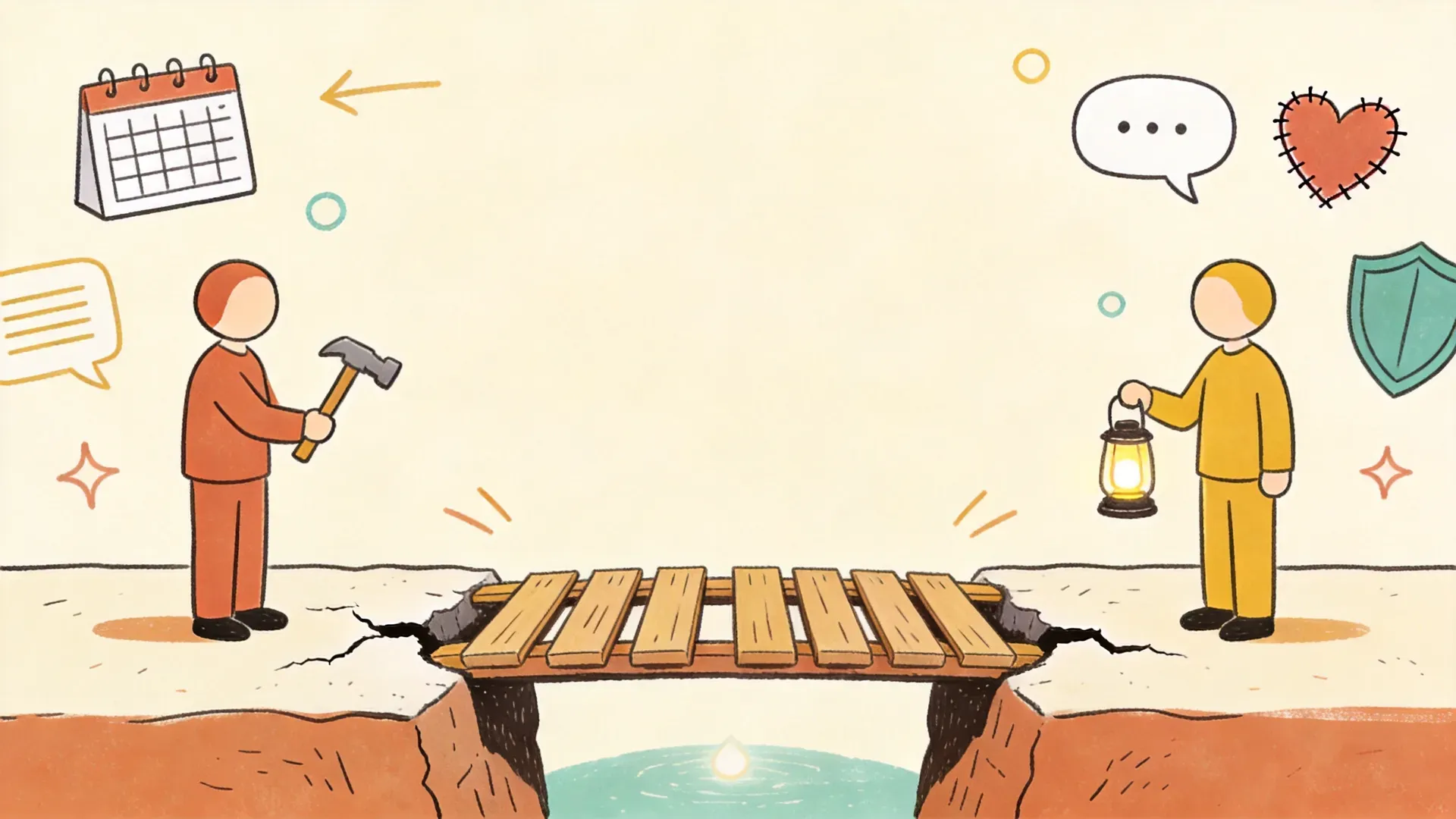
Recovery is not one process. It’s three jobs running at once, and most couples stall because one person is doing all of them, or because the betrayed partner gets drafted into managing the betrayer’s shame.
Job 1, the betrayer: make the future predictable. Accountability, full disclosure, no contact with the affair partner, verifiable change, and patience. The micro-outcome is simple: the betrayed partner has something concrete to check.
Job 2, the betrayed partner: stabilize, then decide. Sleep, support, boundaries around questioning, and a real decision about whether to stay. The micro-outcome is being able to think without flooding.
Job 3, the relationship: write new rules. A transparency agreement, a repair protocol, shared rituals, and a plan for triggers. The micro-outcome is that both people know what happens next.
The diagnostic is blunt. If the betrayer is defensive, Job 1 is stuck. If the betrayed partner can’t function, Job 2 is stuck. If both are willing but nothing changes, Job 3 is stuck.
| Job | First action | You’ll know it’s working when |
|---|---|---|
| Betrayer | Write a full disclosure and end contact | Your partner can check something without asking twice |
| Betrayed partner | Stabilize sleep, support, and questioning | You can think about the betrayal without flooding |
| Relationship | Agree on transparency and repair rules | You both know what happens after a trigger |
There’s also a timeline mismatch that sinks well-intentioned couples. The betrayer wants a finish line: I’ve apologized, I’ve been transparent, when does this end? The betrayed partner needs a process: I need to see it again next week, and the week after. Both needs are real. The negotiation is the work, and it goes better when the couple names the mismatch instead of fighting about it.
Boundaries are the machinery here. If you’ve never thought about consent as an ongoing conversation rather than a single yes, how consent actually works is the right place to start.
The betrayer’s job: accountability that actually counts#
Trust comes back through costly, verifiable behavior over time. Apology volume isn’t the variable.
The first decision is disclosure. Trickle truth is worse than one hard conversation: a detail now, a bigger detail later, a third after that. Each new reveal resets the clock, because the betrayed partner has to update the prediction again. The clinical guidance is a structured disclosure: what happened, when, who, what was concealed, and what is still happening. Then questions, within limits both people agree to.
The second is no contact. Not “we only text about work” unless there’s a written plan for how that works, with the betrayed partner’s input and a way to verify it.
Real accountability has a sound. It’s specific, it doesn’t come with a “but,” and it doesn’t blame the relationship:
- “I did this. It wasn’t because of anything you did.”
- “Here’s what I’ve changed, and here’s how you can check.”
- “I can answer that. Ask me again if you need to.”
What doesn’t count:
- “I’m sorry, but you were distant too.”
- “It’s been three months. Why are you still bringing this up?”
- “I don’t remember” as a permanent answer.
The point of all this is to make change checkable. A shared calendar. Location sharing as a temporary bridge, with a review date. Therapy attendance. Financial transparency. Doing what you said you’d do on a Tuesday, when nobody’s watching. None of it is glamorous. All of it is evidence.
One small study suggests disclosure status matters more than people expect. Among 19 couples who had experienced infidelity, 5 kept the affair secret. Four of those 5 divorced, or 80%. Of the 14 whose affair was revealed, 6 divorced, or 43%. Couples with no infidelity divorced at 23%, or 26 of 113 (Marín, Christensen & Atkins ↗, 2014). Treat those numbers as a direction, not a precise estimate. The group is tiny, and the study can’t prove secrecy caused the divorces. But the direction is consistent with what clinicians describe: secrecy keeps the injury alive.

The betrayed partner’s job: stabilize before you decide#
You don’t owe immediate forgiveness. You also can’t make a good decision while you’re flooded.
Start by separating three things people collapse into one:
- Forgiveness is releasing the debt. It’s for you, and it doesn’t require staying.
- Trust is a prediction that has to be earned back with evidence.
- Reconciliation is the decision to continue the relationship.
You can forgive and leave. You can stay and not trust yet. You can trust someone again without calling it forgiveness. Keeping the three separate makes the next decision clearer.
Before you decide anything, stabilize. Sleep. Eat something. Tell one or two people you trust. Put a boundary around the questioning: one scheduled conversation a day is better than a 2 a.m. loop that leaves both of you wrecked. Some people write a timeline of what they know. It sounds grim; it gives your brain a file to close instead of a loop to run.
Staying is a decision, not a default. A 2026 qualitative study of 11 injured partners who chose to stay identified reasons to stay, the quality of the apology, social support, sexual expectations, therapy, and renegotiated boundaries as core themes (Mitchell et al., Journal of Marital and Family Therapy ↗, 2026). The people in that study didn’t drift back into the relationship. They made a decision, often more than once.
Questions that clarify the decision:
- Is this remorse, or regret at being caught?
- Is this a pattern, or a one-off?
- Is there accountability without me prompting it?
- Is it safe to stay: physically, financially, emotionally?
Scripts that help:
- “I need X to feel safe enough to keep talking.”
- “I’m not deciding today.”
- “I’m not asking for permission to have boundaries.”
When you’re ready to talk about what you want, sexually or otherwise, how to tell your partner what you want in bed is a useful bridge back to the relationship you’re trying to build.

The relationship’s job: build relationship #2#
You’re not restoring the old relationship. You’re negotiating a new one with rules you can both name.
Start with a transparency agreement that has an end date. Decide what is shared (devices, locations, accounts, calendars), for how long, and when you’ll review it. Transparency is a bridge. If it becomes the permanent architecture, you’ve built a surveillance relationship, not a repaired one.
The evidence on that is blunt. In a two-year study of 322 young adults, electronic partner surveillance predicted lower relationship satisfaction a year later (Métellus et al., Journal of Marital and Family Therapy ↗, 2025). The sample was young adults, not specifically couples after betrayal, so don’t overgeneralize. The direction is consistent with what clinicians see: monitoring gives the anxious partner a temporary hit of relief and slowly erodes the thing it’s supposed to protect.
Repair conversations need structure. Pick a time. Put a limit on it. Ban criticism, defensiveness, contempt, and stonewalling, the four patterns Gottman’s research keeps finding. Agree on what happens when a trigger hits: who says what, how you pause, how you come back.
Physical intimacy is its own job. Start with non-sexual touch (hands, shoulders, sitting close), and don’t use sex as a trust test or a scoreboard. If desire has gone quiet, why couples stop having sex covers the common patterns; if distance is part of the picture, keeping a long-distance relationship intimate has the logistics.
Then build rituals. Small, repeatable, low-stakes. A ten-minute check-in. A weekly walk. A shared calendar review. Closeness after betrayal is built in the ordinary moments, not in one grand gesture.
What actually predicts recovery, and how long it takes#
Clinicians who work in affair recovery keep converging on the same predictors: accountability, no contact, tolerance of the betrayed partner’s pain, and real transparency.
The best long-term data I found is small but striking. Marín, Christensen, and Atkins followed 19 couples who had experienced infidelity for up to five years after couple therapy. Couples who stayed did not differ from non-infidelity couples on satisfaction or stability, and their satisfaction rose over time (Marín et al. ↗, 2014). The divorced couples were concentrated in the secret-affair group. That’s the same 80% / 43% / 23% split, and the same caveat: tiny subgroups.
Treatment helps, modestly and specifically. In the 2006 EFT study, 15 of 24 couples resolved the attachment injury after about 13 sessions. A pilot randomized trial of the Gottman Trust Revival Method, with 84 couples, found significant improvements versus treatment-as-usual at six months (Irvine & Peluso ↗, 2024). The abstract doesn’t report effect sizes, so don’t overread it. “Better than usual care in a pilot trial” is a real result, not a guarantee.
The same clinicians tend to agree that the type of affair (emotional, physical, online) and its duration predict less than people expect. What matters is what happens after disclosure.
The timeline, honestly labeled: acute crisis for 1 to 6 months; active repair for 6 to 18; substantial healing around 18 to 24; full restoration for 2 to 5 years, for couples who get there. That’s consensus among Gottman- and EFT-trained clinicians, not a research finding. Milestones are a better guide than a calendar:
- triggers become less frequent and shorter
- the betrayal stops dominating the day
- sleep and appetite return
- curiosity about the future comes back
- you can talk about it without flooding
When rebuilding isn’t the right answer#
Some betrayals shouldn’t be repaired in couples therapy. Safety comes first, and leaving is a valid outcome.
Stop and get individual support if:
- there is physical violence, coercion, or control
- the betrayal is repeated and accountability is absent
- there’s no remorse, only regret at being caught
- contact with the affair partner continues
- substance use or another untreated problem keeps driving the secrecy
Couples therapy can be harmful when there’s abuse. A joint session can increase danger and imply the person who was betrayed shares responsibility for the repair. That’s not a reason to avoid therapy; it’s a reason to choose the right kind, separately if needed. If you’re in the US, the National Domestic Violence Hotline is 1-800-799-7233.
Leaving well is allowed. Individual therapy, legal and financial advice, trusted friends, a plan. No shame framing, no “failed relationship” story. Sometimes the honest ending is the healthiest one.
The point of this guide isn’t to save every relationship. It’s to help you tell the difference between one that can be rebuilt and one that keeps asking you to absorb the cost. Trust isn’t owed. It’s earned, slowly, by behavior. That’s true for the person who broke it, and it’s true for the relationship itself.
Frequently asked questions#
Can you rebuild trust after cheating?#
Yes, under specific conditions: accountability without blame-shifting, no contact with the affair partner, real transparency, and enough time. In one clinical sample, 15 of 24 couples resolved an attachment injury after about 13 emotionally focused therapy sessions (Makinen & Johnson ↗, 2006). Resolution isn’t the same as fully restored trust, but it’s a precondition. Not every couple should try, and not every couple that tries succeeds.
How long does it take to rebuild trust after betrayal?#
Most Gottman- and EFT-trained clinicians put substantial healing at 18 to 24 months, with full restoration taking two to five years for some couples. That’s clinical consensus, not a research finding. Milestones — fewer triggers, better sleep, less obsessive reviewing — are a better guide than a calendar.
Should I check my partner’s phone after they cheated?#
Short-term transparency can be a bridge. Long-term surveillance tends to backfire: in a two-year study of 322 young adults, electronic partner surveillance predicted lower relationship satisfaction a year later (Métellus et al. ↗, 2025). Agree on what is shared, for how long, and when it gets reviewed.
What if they won’t take responsibility?#
You can’t rebuild trust alone. Blame-shifting, minimizing, or continuing contact with the affair partner are reasons to stop couples work and get individual support. Couples therapy is not appropriate when there is ongoing abuse or coercive control.
Is forgiveness the same as trust?#
No. Forgiveness releases the debt. Trust is a prediction that has to be earned back with evidence. Reconciliation is the decision to continue the relationship. You can do one without the others: forgive and leave, stay and not yet trust, or rebuild trust without using the word forgiveness.
What to do this week#
If you’re the one who broke trust, pick one thing your partner says they need and do it this week without announcing it. Then ask what would make the next week easier. If you’re the one who was betrayed, protect one stabilizing habit: sleep, a scheduled conversation, a walk with a friend — and don’t force the decision today.
A couples therapist trained in affair recovery or emotionally focused therapy can help you run these jobs without drowning in them. And if safety is the issue, leave first and sort out the rest later.
So, how do you rebuild trust in a relationship? By changing the evidence a prediction is based on.