Long-Distance Date Ideas That Actually Build Closeness
70% of couples report a relationship ritual, but only agreement predicts satisfaction. 25 long-distance date ideas grouped by four mechanisms.
The call starts the same way every time. How was your day, what did you eat, okay, I should let you go. Nobody is unhappy and nobody is fighting, and the relationship still isn’t accumulating anything.
A shortage of ideas is rarely what’s behind it. The problem is treating every shared activity as interchangeable, as though a movie on Teleparty and a conversation you’ll still be thinking about next month do the same thing to a relationship. They do different things. Research on shared activities is unusually clear on this point: what builds closeness is not the activity itself, but which lever the activity pulls.
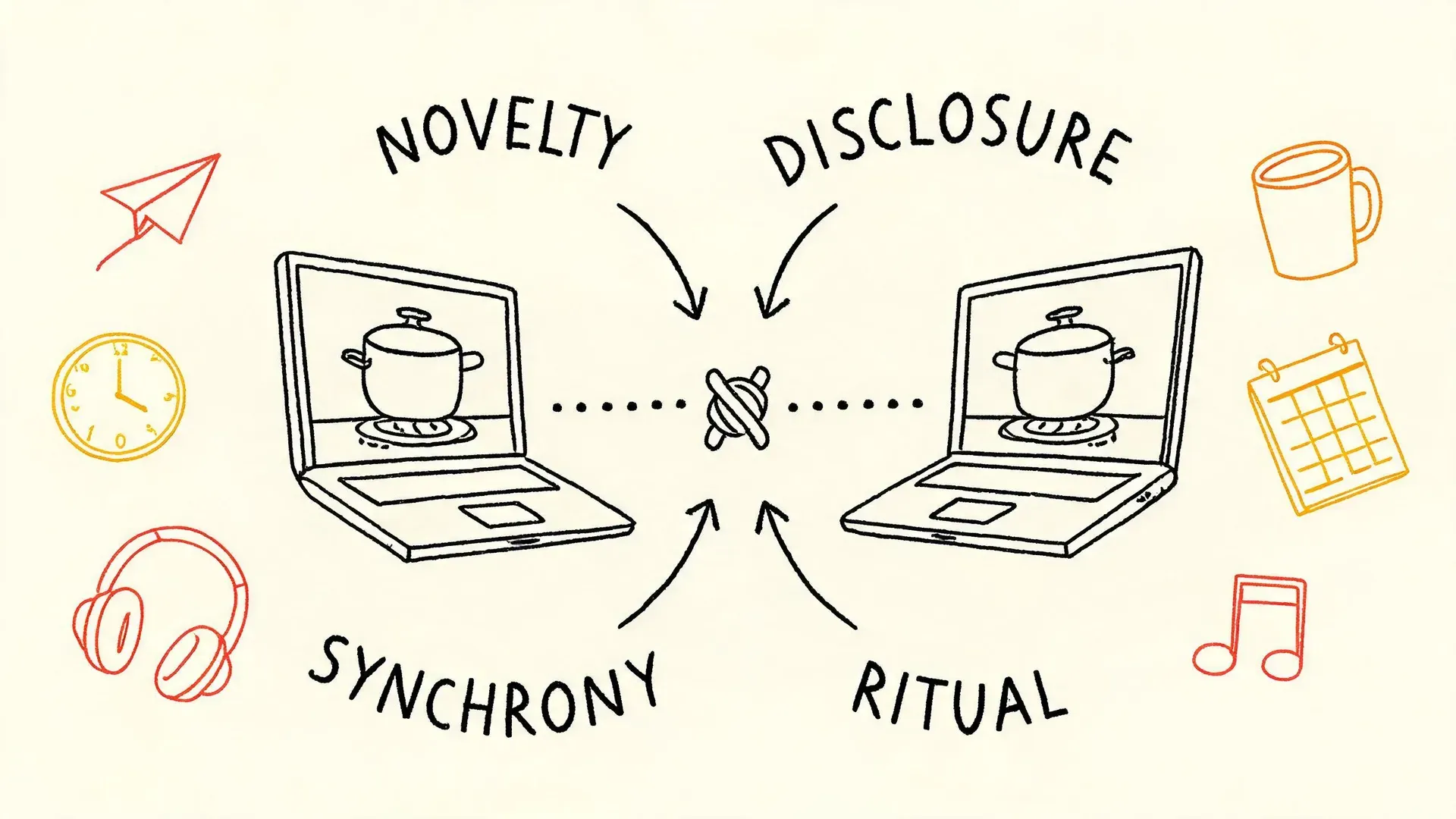
Four levers have solid evidence behind them: novelty, disclosure, synchrony, and ritual. Once you know which one your relationship is short on, choosing a date stops being a creativity problem and becomes a matching problem. For the broader picture of how distance changes intimacy, including the reunion risk almost nobody warns couples about, our guide to keeping a long-distance relationship intimate covers the habit-level side of this.
Key Takeaways
- Distance itself doesn’t predict intimacy. Long-distance couples report closeness equal to or greater than same-city couples, because they disclose more deeply (Jiang & Hancock, 2013 ↗).
- A shared activity builds closeness when it pulls one of four levers: novelty, disclosure, synchrony, or ritual. Pick the lever your relationship is missing, then pick the idea.
- Rituals predict satisfaction, but only when both partners agree the ritual exists. Couples who disagreed about whether they had one were no more satisfied than couples with none (Garcia-Rada, Norton & Sezer, 2019 ↗).
- Novelty doesn’t require a headset or a budget. Shared self-expanding activities don’t have to be physically arousing to work (Tomlinson et al., 2019 ↗).
- A phone lying face-down on the table still lowers felt closeness and trust in conversation, and you won’t notice it happening (Przybylski & Weinstein, 2013 ↗). In a long-distance relationship the phone is both the medium and the distraction, so it takes a rule.
Why most long-distance date ideas don’t work#
An idea list fails when it treats every activity as equivalent, and that is how nearly every roundup is built: forty-five ideas sorted into buckets labelled “fun,” “romantic,” and “cozy,” with no explanation of what any of them does to a relationship. You can work through all forty-five and end up with the same problem you started with.
One number reframes this. In 2023, 12.5% of US newlyweds were in a living-apart-together marriage (not living with their spouse for reasons other than separation), more than double the 5.7% recorded in 1980 (Bankey, NCFMR Family Profile No. 27 ↗, 2025, using Decennial Census 1980 and American Community Survey 2023 data). Distance is not a niche arrangement, and it is not a diagnosis. Most couples run the same two or three formats until those formats stop doing anything.
The four things a date has to do to build closeness#
Each lever has its own body of evidence, and they stack. A single date can pull two or three at once: cooking the same recipe is novelty plus synchrony, and repeating it every Thursday turns it into ritual. Splitting them apart is what lets you aim at the one you’re missing.
Novelty (self-expansion). Couples assigned to shared novel and arousing activities reported better relationship quality than couples assigned mundane ones (Aron, Norman, Aron, McKenna & Heyman, 2000 ↗). The stakes are also long-term: in a study that followed couples for nine years, boredom at the start predicted lower marital satisfaction at the end (Tsapelas, Aron & Orbuch, 2009 ↗).
Disclosure (being known). This is the lever with the strongest evidence specific to long-distance relationships, and the next section unpacks it.
Synchrony (presence). Behavioral synchrony, meaning moving and acting in step, predicted felt closeness and rapport even between strangers (Vacharkulksemsuk & Fredrickson, 2012 ↗). Synchrony is the hardest thing for a video call to fake, and the most reliable thing you can build on purpose.
Ritual (anticipation and commitment). In a survey of 200 people, 70% reported having a relationship ritual, and couples who both acknowledged the ritual were significantly more satisfied than those who had none, or than those who disagreed about whether they had one (Garcia-Rada, Norton & Sezer, 2019 ↗).
Match what you’re feeling to the lever, then start with one of the ideas in that group.
| What you’re feeling | Lever to pull | Start with |
|---|---|---|
| We’ve become logistics partners | Novelty | #1 cook the same recipe, #3 museum mandate |
| We talk constantly and I still feel unknown | Disclosure | #10 what I didn’t say, #8 open-when letters |
| I hang up feeling lonelier than before | Synchrony | #13 parallel coworking, #15 the same meal |
| I can’t remember the last thing we looked forward to | Ritual | #19 name a recurring date, #21 countdown |
| We’re not sure where this is going | Certainty | #24 the reunion-planning date |
Dates that add novelty#
Novelty is the lever long-distance couples neglect most, because “novel” sounds expensive when it usually isn’t. The benefit comes from doing something unfamiliar together, and the evidence on shared self-expanding activities doesn’t require the activity to be physically arousing (Tomlinson, Hughes, Lewandowski, Aron & Geyer, 2019 ↗). Mild and unfamiliar does more for closeness than spectacular and passive.
1. Cook the same recipe in two kitchens. Same dish, same night, two apartments, then plate on camera and give each other a real verdict. This one pulls three levers at once: it’s novel, it’s synchronized, and repeating it turns it into a ritual.
2. Learn a skill in parallel. Pick something neither of you can do: a language, chess openings, three chords on a ukulele. Mastery isn’t the goal. What you want is a thing only the two of you are bad at, which turns out to be a surprisingly durable source of conversation.
3. A museum or Street View wander with a mandate. Give the walk a job. Find the worst painting in the gallery, or identify the house you’d both refuse to live in. A mandate converts a passive screen-share into a shared task, which is what makes it a date.
4. A co-op game mission. Pick something with a shared objective rather than a head-to-head one. Moderate challenge is the sweet spot, and you want the two of you solving a problem together rather than silently grinding.
5. The ten-photo day swap. Ten photos of your ordinary day, no curation, sent with no explanation. This one does double duty, because unposed photos are disclosure in visual form.
6. Take the same free course and compare notes. A short online course on something neither of you knows, one unit a week, then talk about it. It gives you a subject that isn’t work, isn’t the relationship, and isn’t the distance.
Dates that make you known#
Disclosure has the strongest long-distance-specific evidence of the four, so if you work only one lever, work this one. Jiang and Hancock’s diary study found long-distance couples often reported more intimacy than same-city couples, driven by two mechanisms: adaptive self-disclosure, where they shared more and more deeply because the channel demanded it, and idealization, where they saw each other through a slightly rosier lens. Both are things you can also choose to do deliberately rather than leave to chance.
The distinction that matters: a report answers the logistics question (“work was fine”), a disclosure gives them something to know (“I said something stupid in the meeting and I’m still chewing on it”). Most calls are 90% reports.
7. The mundane debrief. A low-stakes daily thread of ordinary detail: the bad sandwich, the weird thing on the train. It reads like filler, and it’s the opposite, because mundane detail is how same-city couples absorb each other’s lives without trying, and it’s the raw material for feeling known.
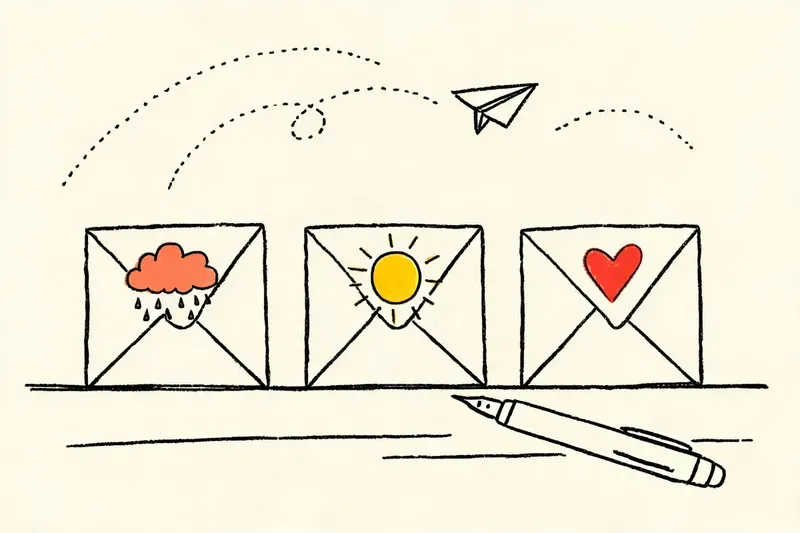
8. Open-when letters. Three sealed notes: open when you’re having a bad week, open when you miss me, open when you can’t sleep. Each one is a disclosure you wrote in advance and they receive at the exact moment it lands. Write them on paper and post them. The delay is part of it.
9. A question-deck date. One real question each, once a week. Arthur Aron’s 36-questions research ↗ showed structured, escalating questions can generate closeness between strangers in under an hour, and it works at least as well on someone you already love.
10. The “what I didn’t say this week” date. One thing each of you held back: a worry, an irritation, something you thought was too small to mention. Small withheld things are what turn into distance over years, and this format gives them a scheduled slot so they never have to arrive as an ambush.
11. Childhood-photo screen-share. Twenty minutes of photos from before you met, with the stories attached. It’s cheap, it’s genuinely novel to your partner, and it surfaces the origin of habits you’ve both been reading as personality quirks.
12. The appreciation-only date. Ten minutes each, no problem-solving, no “but also.” If saying what you want out loud is the hard part for you, how to tell your partner what you want in bed applies the same skill set to a harder conversation.
One more finding matters here: the channel itself matters less than you’d think. In a study of 647 people, texting frequency predicted relationship satisfaction for long-distance couples while voice and video call frequency did not, and the active ingredient was perceived responsiveness, the feeling that a reply actually engages with what you said (Holtzman et al., 2021 ↗). A specific reply to your 2 p.m. complaint does more than a dutiful ninety-minute call where you both perform having a good chat. So a text-heavy week is maintenance, not laziness.
Dates that feel like you’re in the same room#
Presence is what video calls struggle with most, and the newest research suggests it is also what makes the other levers pay off. In two lab experiments with couples (183 and 141 couples), shared novel activity in virtual reality produced a stronger sense of “my partner was there with me” than the same activity over video, and greater presence tracked with more self-expansion, less boredom, and better relationship quality (Balzarini, Sharma & Muise, 2025 ↗, Behavioral Sciences).
The headlines left out the caveat. In that same paper, the direct effects on self-expansion and relationship satisfaction were inconsistent across the two studies, and the authors concluded that virtual interaction may have less potential than in-person interaction to promote self-expansion. Presence is still worth chasing, and you don’t need a headset to get it.
13. Parallel coworking. Both of you working, camera on, mostly silent, for a set block. It sounds like nothing. It’s the closest thing to sharing a room, and it’s the only date format here that costs zero attention.
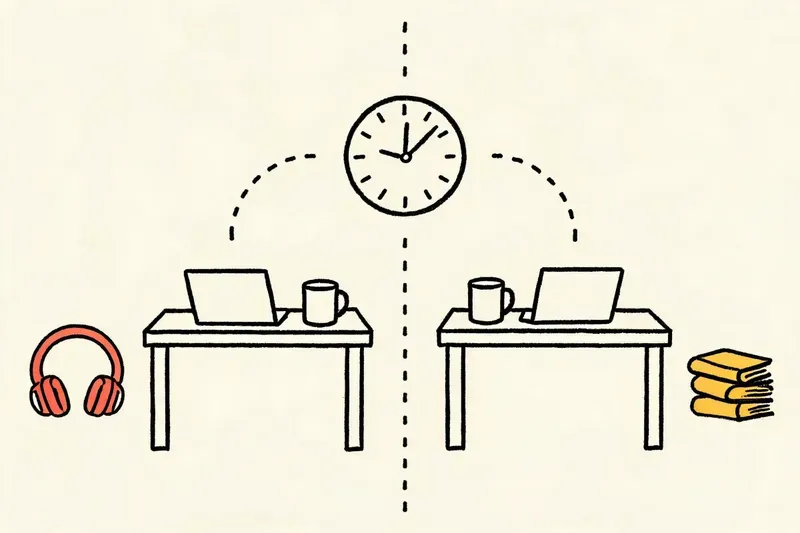
14. A synchronized workout or stretch. Same video, same time, cameras on. Moving in step is the most literal version of the synchrony finding, and it works even when neither of you is fit.
15. Eat together at the same hour. You’ve already got a cooking date in the novelty group. This is the version for a Tuesday you can’t face a recipe: order in separately, or heat up leftovers, and put the laptops at the table at the same time. The shared hour is doing the work, not the food.
16. A watch party with live commentary. A film with the chat open, so it’s a shared reaction rather than two people watching the same file. Keep it to things you’d heckle. This format is for commentary, not analysis.
17. A stargazing or sunrise call. One of you gets up early, or both of you go outside at the same hour and point a phone at the sky. It’s a shared room made of a shared view, and the time-zone gymnastics become part of the story.
18. Fall asleep on call. No conversation required. It’s the least efficient and most humanizing item on this list, and it’s the one couples consistently report missing when they stop.
Dates that become rituals#
If you do exactly one thing from this article, name a recurring date. The evidence here is oddly specific, and the specificity is what makes it easy to act on.
In the 2019 survey of 200 people, 70% reported a relationship ritual, and the satisfaction benefit showed up in one particular place. Couples who both acknowledged the ritual existed were significantly more satisfied than couples with no ritual, and than couples who disagreed about whether they had one. A ritual you think you have and your partner doesn’t isn’t a ritual. It’s a habit one of you is keeping alone.
The other finding is encouraging for anyone on a budget. Among the rituals couples described, 63% were date or leisure activities, and 64% involved consuming a good or service. You don’t need to invent something sacred, only to name something you already do.
19. Name a recurring date out loud. Pick a slot, give it a name, and confirm you both call it that. “We text every day” is ambient, not ritual. A named Thursday-night cook-along is.
20. Recreate your first date, annually. Same restaurant if you can, same film if you can’t, same order. It’s a ritual with a built-in story, and it costs one evening a year.
21. A countdown to the next visit. A shared countdown or calendar with the next in-person date on it, visible to both of you. Anticipation is a resource, so don’t leave it unspent.
22. A monthly relationship retro. Twenty minutes: what worked, what felt off, one thing to change. Ritualizing the maintenance conversation stops it from only ever happening during a fight.
Dates that build certainty about the future#
Relationship certainty, meaning confidence that the relationship has a future, is one of the strongest predictors of satisfaction in long-distance couples. That comes from a 2015 study of more than 700 people, which also found no difference in relationship or sexual satisfaction between long-distance and same-city couples at all. The predictors were certainty, low personal distress, and face-to-face contact (Dargie, Blair, Goldfinger & Pukall, 2015 ↗).
One rule makes this group work: a concrete plan should leave the call, because a date isn’t planning unless something real changes by the end of it.
23. Dream-trip itinerary with real logistics. Plan a trip you might actually take. Real dates, real budget, real flights. The moment it stops being hypothetical, you’ve manufactured certainty in an evening.
24. The reunion-planning date. Open the airline site during the date and book the next visit. This is the single highest-value hour you can spend on the relationship, and our guide to staying intimate across distance explains why the reunion itself is the phase couples most often fail to prepare for.
25. Design your future home. Floor plan, city, the room that matters most to each of you. It’s a low-stakes way to find out whether your assumptions about the future actually match.
How to make any of these feel like a date, not a call#
The mechanics do most of the work. Same two people, same conversation, different framing, and it lands as a date.
- Phone face-down, or better, in another room. In two experiments with pairs of strangers, the mere presence of a mobile phone on the table lowered how closely related people felt and how much they trusted each other, and debriefs suggested participants had no idea it was happening (Przybylski & Weinstein, 2013 ↗). In a long-distance relationship the phone is the relationship, which is exactly why the second device on the table matters.
- Get out of bed. Where you take the call sets what kind of call it is.
- Give it a start and an end. Sixty to ninety minutes, ending on purpose rather than trailing off. Open-ended calls are how “we talk for three hours” and “I feel far away” coexist.
- Rotate the bad time slot. If one of you always takes the 6 a.m. call, that’s an asymmetry rather than a schedule. Alternate it.
- Have the thing ready before the call starts. Recipe chosen, film queued, question picked. Scrambling for fifteen minutes is not a date.
- Dress like it’s a date. Not for vanity, but because it changes how you frame the hour for yourself, and that framing is most of what makes the hour feel like a date.
Mistakes that make long-distance dates fall flat#
Three mistakes account for almost all flat virtual dates: treating the date as an open-ended call, choosing by mood instead of by lever, and letting one partner do all the planning.
The highlight-reel trap. If every date is your curated best self, your partner falls for a version of you that an ordinary Tuesday can’t compete with. That bill comes due at the reunion, where roughly one in three long-distance couples break up within three months of reuniting (Stafford & Merolla, 2007 ↗). The idealization that helps you across the distance is the same thing that sets up the crash. Curate less, disclose more.
The spectacle trap. Going bigger when a date falls flat is the intuitive move and the wrong one. The evidence favors moderate novelty plus full attention over production value, and the newest VR research found virtual novelty’s effects on satisfaction were inconsistent even when presence improved. A flat date needs a task rather than more equipment.
The “when we’re not tired” trap. An unnamed date is the one that gets cancelled, which is why the ritual section asks you to name one.
And if the staleness feels bigger than scheduling, if the same routine seems to be draining desire generally rather than just draining fun, that’s a different problem with its own research, covered in why couples stop having sex.
Frequently asked questions#
How often should long-distance couples have date nights?#
There’s no research-backed number, and frequency isn’t what predicts satisfaction; agreement is what does. Couples who both acknowledged a recurring ritual were significantly more satisfied than those who didn’t, or who disagreed about whether one existed (Garcia-Rada et al., 2019 ↗). One named recurring date plus spontaneous ones is a workable shape for most couples. A packed calendar of dates neither of you looks forward to isn’t better.
What do you talk about on a virtual date?#
Disclosure, not logistics: one specific feeling, one thing you didn’t say this week, one shared plan. Long-distance couples report intimacy equal to or greater than same-city couples specifically because they disclose more deeply (Jiang & Hancock, 2013 ↗). The bar here isn’t interesting topics so much as specificity.
Do virtual dates actually work?#
Yes for presence, mixed for satisfaction. In lab experiments, couples who shared a novel activity in virtual reality reported a stronger sense of their partner being there with them than couples who did the same activity over video, and rated themselves less bored (Balzarini, Sharma & Muise, 2025 ↗). But the direct effects on self-expansion and relationship satisfaction were inconsistent across the paper’s two studies, and the authors note virtual interaction may carry less self-expansion potential than being in the same room. Treat virtual dates as genuine maintenance rather than a full replacement.
What if we’re in different time zones?#
Rotate the inconvenient slot instead of letting the same person always absorb it, and lean on asynchronous formats for the rest of the week: voice notes, letters, the ten-photo swap. Then treat the synchronous date as the premium slot it is. Distance shows up as resentment through asymmetry long before it shows up as scheduling failure.
The short version#
Twenty-five ideas, four levers, one rule of thumb: pick the lever your relationship is missing, then pick the idea.
If you feel like logistics partners, take something from novelty. If you feel unknown, take something from disclosure, the lever the long-distance research backs hardest. If you hang up feeling lonelier, take something from synchrony. If you can’t remember the last thing you looked forward to, name a ritual and check that you both agree it exists.
Then do one of these this week, and put the phone in another room. For the habit-level research on distance, including how often to talk and what predicts satisfaction, read how to keep a long-distance relationship intimate, and for how closeness works in any relationship, start with building intimacy in a relationship.