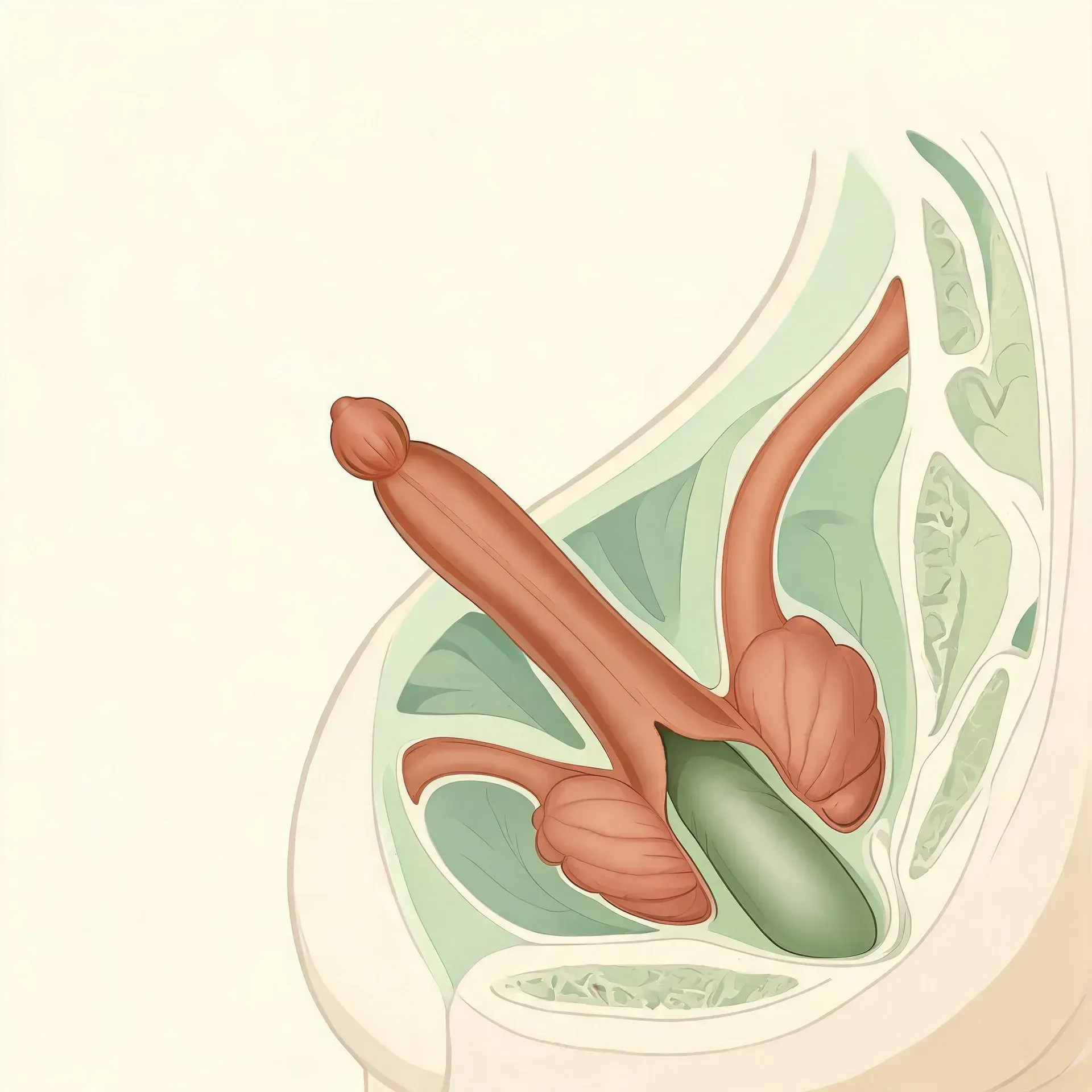
Where Is the Clitoris, Really? Anatomy Nobody Taught You
The clitoris is about 90% internal, with over 10,000 nerve fibers — twice the penis. Here's the anatomy most people never learned, and why it matters.
Ask most people to point to the clitoris and they’ll gesture at a small external bump, the glans, tucked at the top of the vulva where the inner labia meet. That’s the part you can see. It’s also, anatomically speaking, almost beside the point.
Here’s the finding that reframes everything: when urologist Helen O’Connell and her colleagues dissected and imaged the clitoris in the early 2000s, they showed that roughly 90% of the organ is internal, hidden beneath the skin and wrapped around the urethra and the front wall of the vagina (O’Connell, Sanjeevan & Hutson, Journal of Urology ↗, 2005). The visible glans is the tip of a much larger structure, one that most anatomy textbooks, and nearly all sex education, simply left out.
This is the anatomy lesson you almost certainly never got. Not because it’s obscure, but because it was omitted.
Of all the questions readers send me, “where is the clitoris, actually?” is one of the most common, and one of the most understandable. It’s the question that tells you just how thoroughly this anatomy was left out.
Key Takeaways
- The clitoris is not a small external “button.” It’s a large, mostly internal organ; the visible glans is only about 10% of the whole structure (O’Connell et al., 2005).
- It carries over 10,000 nerve fibers, roughly double the penis, making it one of the most densely innervated structures in the human body (OHSU/Peters et al., 2022).
- Its internal “legs” and bulbs wrap around the urethra and the front vaginal wall, which is the anatomic basis for what people call the “G-spot” (Buisson & Foldès, 2010).
- Because most of it is internal, “clitoral” and “vaginal” stimulation are not separate systems. They’re different routes to the same organ.
- Knowing this anatomy changes how you understand arousal, pleasure, and why penetration alone so often isn’t enough.
So where is the clitoris, exactly?#
The honest answer: mostly inside the body. The part you can see and touch, the glans, is a small, pea-sized structure at the front of the vulva, partly covered by a fold of skin called the clitoral hood. But that’s the exterior of an organ that extends several centimeters inward.
O’Connell’s team, using a combination of cadaver dissection and MRI on living women, mapped the full structure for the first time in modern terms. They found that the internal components, the body (corpora), the two “legs” (crura), and the bulbs of the vestibule, account for about 90% of the clitoris, while the glans accounts for only about 10% (ASU Embryo Project Encyclopedia ↗). The crura are the longest part, curving back along the pubic bone. The bulbs are masses of erectile tissue sitting between the crura and the vaginal wall.
The researchers also found that the clitoris doesn’t sit in isolation. It forms an interconnected, pyramid-shaped complex with the urethra and the vagina, sharing nerves and blood vessels on both sides. In other words, the clitoris, urethra, and front vaginal wall function less like separate organs and more like one integrated structure.
That’s a very different picture from the textbook diagram of a tiny external nub, and it’s the correct one.
The anatomy you never saw in a textbook#
If you picture the visible glans as the tip of an iceberg, you have the right mental model. The majority of the clitoris is submerged, and it has three main internal parts.
Let’s name the parts, because having the words is half the battle:
- The glans: the only external part, packed with nerve endings. This is what most people mean by “the clitoris.”
- The body (corpora cavernosa): two cylinders of erectile tissue extending inward from the glans, the same kind of tissue that fills the penis.
- The crura (“legs”): two long arms that branch off the body and curve back along the pubic arch. These are the longest part of the organ.
- The bulbs of the vestibule: two masses of erectile tissue on either side of the vaginal opening, nestled between the crura and the vaginal wall. When aroused, they swell.
All of these are erectile. During arousal, the whole internal structure, not just the glans, engorges with blood. That full-body engorgement is what “arousal” physically is, and it happens largely out of sight.
Why is it so sensitive? The nerve supply, explained#
Because it’s built almost entirely for sensation. The clitoris has no reproductive function. It doesn’t make eggs, carry a pregnancy, or pass urine. Its only known job is pleasure, and its wiring reflects that.
In 2022, a team led by surgeons Blair Peters and Maria Uloko measured the nerve supply directly. Examining dorsal clitoral nerve tissue from volunteers, they counted roughly 10,281 nerve fibers, and reported that the clitoris carries more than 10,000 fibers in total (OHSU ↗, 2022). For comparison, the penis is commonly cited at around 4,000. So the clitoris, a much smaller organ, packs in about twice the nerve fibers.
There’s one more wrinkle worth knowing, and it corrects a popular myth. Many people have heard that the clitoris is “mapped” on the surface of the brain in a specific spot on the sensory cortex, the way a fingertip is. Brain-imaging work led by researchers including Nan Wise and Barry Komisaruk found something more interesting: clitoral, vaginal, and cervical stimulation each activate distinct but overlapping regions of the sensory cortex: the brain treats them as related but separable sources of sensation (Komisaruk et al., Journal of Sexual Medicine ↗, 2011). The neural picture is more distributed than the tidy textbook map suggests.
The “G-spot” is the clitoris, felt from the inside#
This is where the internal anatomy pays off. The short answer: the “G-spot” isn’t a separate, magical structure. It’s most likely the clitoris, felt from the inside.
Because the clitoral crura and bulbs wrap around the front (anterior) wall of the vagina, pressure on that wall, a few centimeters in toward the belly, is really pressure on the internal clitoris. Sonographers Odile Buisson and Pierre Foldès demonstrated this directly: using ultrasound during arousal, they showed the clitoral root moving and pressing against the anterior vaginal wall, and that stimulating that wall deforms the clitoris (Buisson & Foldès, Journal of Sexual Medicine ↗, 2009–2010).
That finding reframes a long and often frustrating debate. Rather than a distinct organ that some women have and others don’t, the “G-spot” is better understood as the place where the internal clitoris can be most easily reached through the vaginal wall. Whether stimulation there feels good varies from person to person, because bodies vary, but the anatomy underneath is the same organ.
Some researchers go further and argue the vagina has no erectile or sensory tissue of its own that could produce a purely “vaginal” orgasm, that what’s called a vaginal orgasm is really the internal clitoris responding to pressure (Puppo, Clinical Anatomy, 2013). That view is debated, and a systematic review concluded the “G-spot” as a discrete structure remains unproven (Vaccaro et al., International Urogynecology Journal ↗, 2021). But the broad consensus is clear: the internal clitoris and the front vaginal wall are anatomically inseparable.
Clitoral vs. vaginal orgasm: a false divide?#
Once you accept that most of the clitoris is internal, the famous distinction between “clitoral” and “vaginal” orgasms starts to dissolve.
If nearly all the organ’s erectile tissue sits against the vaginal wall, then stimulation through the vagina and stimulation of the external glans are two routes to the same destination. That’s why some anatomists now use an umbrella term, the clitorourethrovaginal complex, to describe the whole interconnected region, rather than pretending the parts work independently.
This has a real, practical consequence. Decades of research show that a majority of women do not reliably reach orgasm from penetration alone and need direct or indirect clitoral stimulation. That’s not a defect, and it’s not a mystery. It’s exactly what the anatomy predicts: the most nerve-dense part of the organ is the external glans, and penetration stimulates it only indirectly.
The takeaway: “Clitoral” and “vaginal” orgasms aren’t two different biological phenomena competing for legitimacy. They’re different paths to the same mostly-internal organ. If penetration alone isn’t enough, that’s not a shortcoming. It’s the anatomy doing exactly what it’s shaped to do.
This is also the anatomic root of the orgasm gap, the well-documented finding that heterosexual women orgasm far less often than men during partnered sex. When sex scripts center penetration and sideline the clitoris, they ignore the organ most responsible for female pleasure. We dig into that data in our guide to sex education for adults.
A physician walks through the full anatomy in this video:
Why so few of us were ever taught this#
Because for most of medical history, nobody bothered to look. The omission of the clitoris from textbooks wasn’t an accident of incomplete knowledge. Accurate descriptions of its internal structure existed as far back as the 1840s. O’Connell’s team made this point bluntly: anatomists had the correct information for well over a century, and textbook writers simply didn’t include it (ASU Embryo Project Encyclopedia ↗).
O’Connell has argued that this reflects cultural bias rather than scientific ignorance. The clitoris: an organ with no role in reproduction, devoted entirely to female pleasure. It was systematically minimized, mislabeled, or left out of the diagrams students learned from. Even modern anatomy texts often shrank it or omitted the internal crura and bulbs entirely.
The consequences show up in ordinary adult knowledge. When researchers ask people to label the anatomy of the vulva, most can’t, and the clitoris itself is misidentified or confused with the urethra by a large share of respondents. We covered that data in our sex education refresher, but the short version is this: the gap in your knowledge isn’t a personal failing. It’s the predictable result of a subject that was, for generations, deliberately under-taught.
The good news is that this is fixable, and it’s being fixed. Modern imaging, better dissection, and a generation of researchers have put the full clitoris back on the map. What’s left is for the rest of us to learn it.
This short documentary meets some of the scientists and educators working to correct the record:
What does this change in practice?#
Knowing the anatomy isn’t just trivia. It has concrete implications for pleasure and for sex.
Arousal is a whole-organ event. Because the internal clitoris engorges along with the glans, arousal takes time. Rushing straight to the most sensitive spot often skips the gradual, full-body engorgement that makes touch feel good rather than intense or even uncomfortable.
Indirect stimulation counts. Since the internal bulbs and crura surround the vaginal opening and front wall, pressure and movement around the vulva, not just directly on the glans, stimulate the clitoris. There’s no single “right” spot; there’s a whole structure.
Penetration is one input, not the main event. For most women, the external glans is where the densest sensation lives. Positions and touch that include it aren’t an add-on; they’re the point.
Bodies vary, and that’s normal. How the internal anatomy sits, how sensitive the glans is, and what kind of pressure feels good differ from person to person. The map above is a starting point, not a rulebook. The only reliable guide is feedback from the actual person.
If there’s a single idea to carry away, it’s this: the clitoris is not a button to find but a structure to understand. Once you see the whole thing, a lot of confusion about arousal, about orgasm, about why “the usual script” so often falls short quietly resolves.
[INTERNAL-LINK: how arousal actually works → understanding arousal and desire] [INTERNAL-LINK: why penetration alone often isn’t enough → the orgasm gap explained]
Frequently asked questions#
Is the clitoris really just a small bump?#
No. The visible glans is only about 10% of the organ. The other 90%: the body, the two crura, and the bulbs of the vestibule, all internal, wrapping around the urethra and the front wall of the vagina (O’Connell et al., 2005).
How many nerve endings does the clitoris have?#
More than 10,000 nerve fibers. A 2022 OHSU study counted roughly 10,281 in the dorsal clitoral nerve alone. That’s about double the commonly cited figure for the penis, in a much smaller organ.
Is the G-spot the same as the clitoris?#
Not exactly, but they’re connected. The “G-spot” is best understood as the area of the front vaginal wall where the internal clitoris (the crura and bulbs) can be felt through the tissue. Ultrasound studies show that stimulating that wall moves the clitoris itself (Buisson & Foldès, 2009–2010).
Are vaginal and clitoral orgasms different?#
The anatomy suggests they’re two routes to the same organ. Because most of the clitoris lies against the vaginal wall, stimulation through the vagina and stimulation of the external glans both act on the clitoris. Some anatomists group the whole region as the “clitorourethrovaginal complex.”
Why wasn’t this in my biology textbook?#
Accurate descriptions existed since the 1840s, but textbook writers omitted or minimized the clitoris’s internal structure for over a century. Researchers attribute this to cultural bias. An organ devoted to female pleasure was systematically under-taught. Modern imaging has now corrected the record.
Where to go from here#
The clitoris isn’t small, simple, or mysterious. It’s a large, mostly internal, exquisitely sensitive organ that anatomy education spent generations ignoring. Learning where it actually is, and how it’s really built, is one of the most useful things you can do for your understanding of pleasure, arousal, and your own or your partner’s body.
Keep building the picture:
- The full refresher: sex education for adults — the facts you never got taught
- Context on satisfaction: is there a normal amount of sex?
- [INTERNAL-LINK: the orgasm gap, explained by the data → orgasm gap guide]
- how to talk with a partner about what feels good
The fact that this anatomy feels new to you isn’t a reflection on you. It’s a reflection of what you were never shown. Now you’ve seen it.
This article is educational and not a substitute for medical advice. For anything personal, persistent, or painful, talk to a qualified clinician.