What Happens at a Sexual Health Checkup?
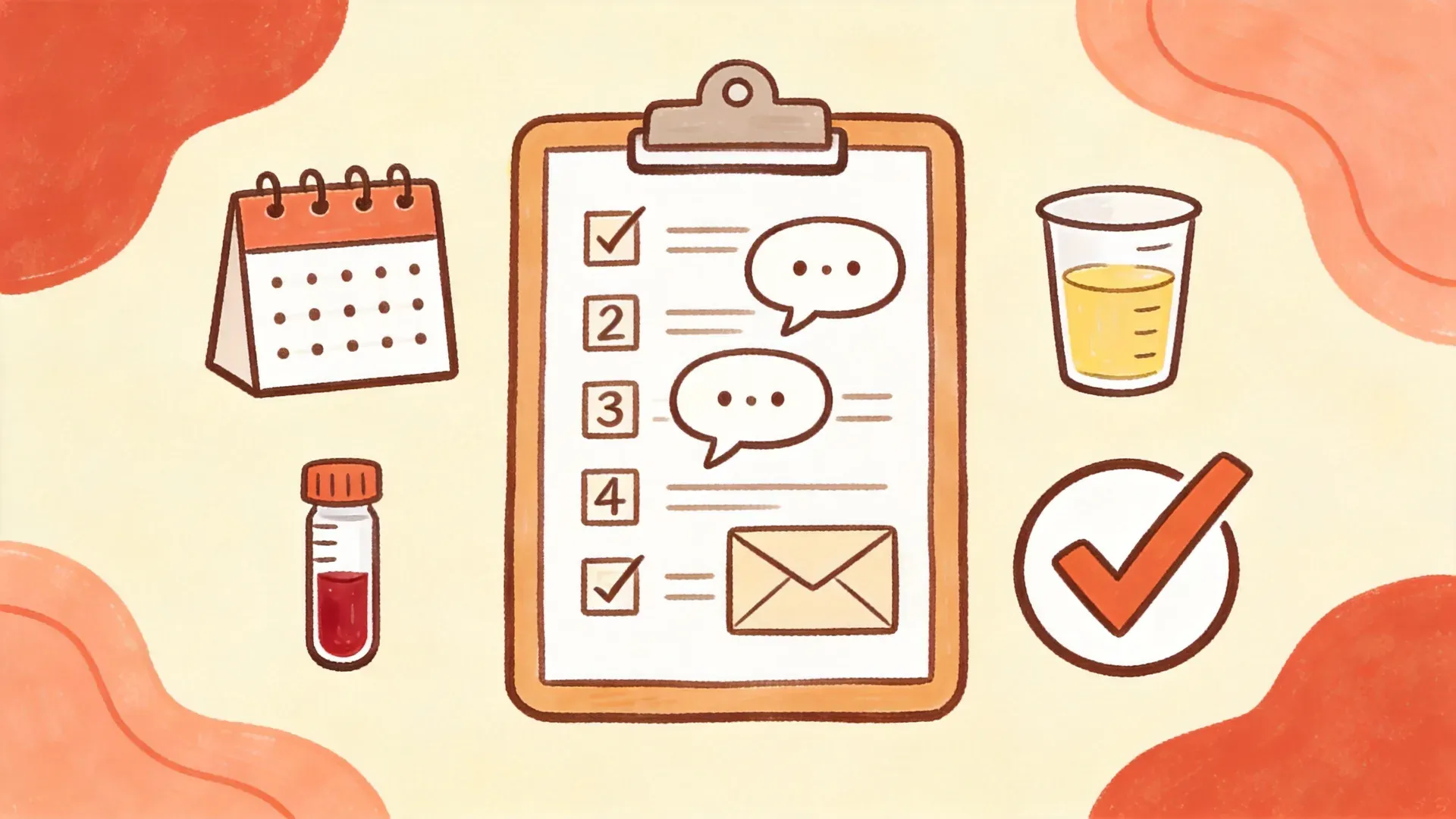
A sexual health checkup takes 15–30 minutes and is mostly a conversation plus a urine sample. Here's every step, from booking to results.
Nobody works themselves into a panic about a dental cleaning. But “sexual health checkup” sounds like it involves stirrups, judgment, and at least one medieval instrument. So people put it off. In a 2026 national survey of 2,555 US adults, 47% had never been tested for an STI other than HIV, and half had never been tested for HIV (Journal of Sex & Marital Therapy ↗, 2026).
Here’s what the appointment actually is: a short conversation, a urine sample, maybe a small blood draw, and you’re out the door in under half an hour. No exam unless you have symptoms. No lecture. Below is the whole thing, step by step, including the parts people worry about that don’t actually happen. (This is general education, not personal medical advice. A clinician who knows your history beats any article, including this one.)
Key Takeaways
- It’s mostly talking and peeing in a cup. A routine symptom-free screening is a conversation plus a urine sample and a blood draw. Physical exams only happen when you have symptoms.
- Expect 15–30 minutes, door to door. Longer only if you need an exam or same-day treatment.
- You often have to ask for it. In one analysis, 40% of people getting contraceptive care who had a reason to test were never offered STI testing (Child Trends ↗, 2022). Ask by name.
- Results take days, not weeks, usually via a patient portal or text. Ask about the “no news is good news” policy before you leave.
- It’s confidential and often free. Insurance covers screening as preventive care, and health departments and community clinics test on sliding scales.
Before you go: booking takes five minutes, prep takes almost none#
You can get a sexual health checkup at your regular doctor’s office, a community or sexual health clinic, a health department, Planned Parenthood, an LGBTQ+ clinic, or a campus health center. At-home test kits are a legitimate option too, with a caveat we’ll get to.
Here’s the part worth knowing before you book: you may need to ask for the test directly. A 2022 Child Trends analysis found that 40% of contraceptive-care clients who had a reason to test said their provider never offered or even asked about STI testing. Routine physicals often skip STI screening entirely. So say the words: “I’d like a full STI panel.” That one sentence is the difference between assuming you were tested and actually being tested.
Prep is nearly zero. No fasting. The one common instruction: try not to pee for an hour or two before the appointment, because the chlamydia and gonorrhea test usually runs on a urine sample and a fresh bladder makes it easier. Bring your ID, your insurance card if you have one, and any questions written down, because brains empty out the moment a clinician says “any questions?”
One timing note: if you have symptoms right now (discharge, sores, burning, pain), don’t wait for an annual slot. Book whatever’s soonest and say why when you schedule. And if you recently had a new partner or a condom break, check the timing before you go. Tests have window periods, so a test taken too soon after an exposure can come back falsely reassuring. The details are in our guide to how often you should get tested.
Step 1: the conversation (yes, they ask about your sex life)#
The appointment starts with questions. Expect some version of: How many partners recently? Men, women, or both? What kinds of sex: oral, vaginal, anal? Condoms or not? Any symptoms? Any past STIs? If you use PrEP, when you started?
This is the part people dread, and the part that’s easiest to get through once you know why it’s happening. The clinician isn’t collecting gossip. Your answers determine which tests you need and, just as important, which body parts get tested. Chlamydia and gonorrhea infect the throat and rectum as well as the genitals, and a urine test only checks the genital tract. If oral sex is part of your life and nobody swabs your throat, that infection goes undetected. There are several STIs you can get from oral sex, which is exactly why the questions are this specific.
If it helps, rehearse one-sentence answers:
“Two partners in the past year, both women.” “Oral and vaginal, condoms sometimes.” “No symptoms, just want a routine check.”
That’s genuinely all it takes. They’ve heard everything, thousands of times, and their job performance is measured in tests ordered, not eyebrows raised.
Still, the awkwardness is worth naming, because it keeps real numbers of people home. In one Australian survey of young people, 45% considered STI testing embarrassing, and a quarter worried about confidentiality (Australian & New Zealand Journal of Public Health ↗, 2016). Research on urban youth found that higher STD-related stigma independently cut the odds of ever testing, roughly in half for both men and women (PMC ↗, 2014). The stigma is the health risk. The appointment is the cure.
Step 2: Samples, which means urine, blood, and maybe a swab you take yourself#
After the conversation, you collect samples. For most people without symptoms, this is the entire “medical” part of the visit, and it takes about five minutes:
| Infection | Sample it usually needs |
|---|---|
| Chlamydia | Urine, or a swab (throat/rectal/vaginal depending on the sex you have) |
| Gonorrhea | Same: urine or site-specific swab |
| HIV | Blood draw, or a finger-prick/oral-swab rapid test |
| Syphilis | Blood draw |
| Herpes | Swab of an active sore; blood tests only in specific situations |
Two details that surprise people. First, self-swabbing is normal now. Many clinics hand you the swab and point you to a private bathroom. You do it yourself, no audience, thirty seconds. Second, the blood draw is small: a vial or two for HIV and syphilis, not a donation bag. If needles aren’t your thing, say so. Rapid HIV tests run on a finger prick or a mouth swab, with results in about 20 minutes.
Worth repeating from Step 1, because it’s the single most-missed piece of a checkup: urine alone doesn’t cover throat or rectal infections. If those sites are relevant to your sex life, say it out loud during the conversation so they get swabbed.
Step 3: the physical exam that (usually) doesn’t happen#
Now for the biggest gap between imagination and reality. If you have no symptoms, a routine screening typically involves no genital exam at all. Nobody asks you to undress. The whole visit stays fully clothed except for a rolled-up sleeve.
An exam gets added when you report something specific: sores, bumps, discharge, itching, pain. In that case the clinician looks at the area, possibly takes a swab of the spot, and that’s it. You can ask for a chaperone, ask them to narrate before they do anything, and decline any part of it. Saying “can you tell me what you’re about to do before you do it” is a completely normal request.
For women, one distinction matters: a Pap test (screening for cervical cell changes and HPV) is a different thing from STI screening, on its own schedule. One doesn’t include the other. If you’re due for both, ask whether they can happen in the same visit.
Why screen at all if there are no symptoms to examine? Because the most common infections are usually silent. Chlamydia and gonorrhea frequently cause no noticeable symptoms, especially early, while still doing damage and still passing to partners (CDC STI Treatment Guidelines ↗, 2021). That asymptomatic majority is the entire argument for the boring, exam-free checkup. And if pain during sex is the symptom that finally got you through the door, our guide to common causes of pain during sex can help you describe it precisely, which gets you better answers faster.
Step 4: Results, and the strange silence of “no news”#
You leave. The lab does its part. Most results land within a few days to two weeks, delivered through a patient portal, a text, or a call. Many clinics run a “no news is good news” policy, meaning negatives never get a call at all. Before you walk out, ask two questions: how will I get each result, and does silence mean negative? That kills a week of unnecessary portal-refreshing.
Two things to understand about whatever comes back. First, window periods. Every test has a stretch after exposure when an infection can be present but undetectable: roughly 1–2 weeks for chlamydia and gonorrhea, 3–6 weeks for syphilis, up to 45 days for a lab HIV test. If your last possible exposure was inside the window, the plan is test now, retest after the window closes.
Second, a positive result is not the catastrophe it feels like at 2 a.m. Chlamydia, gonorrhea, and syphilis are curable with standard antibiotics, often prescribed on the spot or with one follow-up visit. HIV is a manageable chronic condition with modern treatment. Partner notification is handled confidentially, often anonymously through the health department. Nobody calls your partner with your name attached.
What it costs, and where to go if you’re uninsured#
In the US, STI screening counts as preventive care, and many plans cover recommended screenings with no copay, though you should check your plan’s specifics, since exactly which tests are covered can depend on age and risk factors. If you’re uninsured or don’t want the visit on a family insurance statement, you have real options:
- Health departments run low-cost or free STI clinics in every state.
- Planned Parenthood and community clinics charge on sliding scales based on income.
- LGBTQ+ centers and campus clinics often test free, no insurance questions asked.
- At-home kits let you mail in self-collected samples for chlamydia, gonorrhea, and HIV. They’re a solid option for routine screening, with two limits: they usually can’t test throat and rectal sites, and symptoms deserve an in-person visit.
Cost is a real barrier, but it’s a smaller one than the inside of our heads. CDC analysis of insurance claims found that annual HIV testing never topped 4% of commercially insured adults or 5.5% of Medicaid enrollees in any year studied, despite universal screening recommendations (AJMC ↗, 2023). The tests were covered. People just weren’t going. Which loops back to why you’re reading an article about what the appointment is like: the unknown is the wall, and it’s a cardboard one.
After: one checkup is a snapshot, not a shield#
A clean panel tells you your status on the day the samples were taken, full stop. It says nothing about next month. How often to repeat depends on your life: yearly is a sensible baseline when you’re sexually active, and every 3–6 months makes sense with new or multiple partners. The testing-frequency guide linked earlier has the full breakdown by situation.
The context that makes routine testing worth the calendar slot: people aged 15–24 accounted for nearly half (48%) of all reported chlamydia, gonorrhea, and syphilis cases in 2023, and 56% of reported chlamydia cases alone, while making up only about a quarter of the sexually active population (CDC 2023 STI Surveillance Report ↗, 2025). And while US STI rates finally dipped 1.8% from 2022 to 2023 after years of climbing, the absolute burden stays enormous, with CDC’s 2024 data release showing well over a million new reported infections (PMC ↗, 2025; CDC ↗, 2025).
If you’ve never been tested, you’re in the majority, which is a strange sentence and a true one:
Booking once puts you ahead of most of the country. Booking regularly puts you in genuinely rare company. And once you’ve done it, the next conversations get easier: it’s a lot simpler to talk to a new partner about STI testing when your own status is a fresh fact instead of a vague assumption.
Frequently asked questions#
Does a sexual health checkup hurt?#
No. For a routine screening without symptoms, the most uncomfortable moment is a standard blood draw, and even that can be swapped for a finger prick if you ask. Swabs are usually self-collected in a private bathroom. Nothing about the appointment involves pain.
Is a sexual health checkup confidential?#
Yes. Standard clinician-patient confidentiality applies, and clinics that specialize in sexual health are practiced at discretion, from how they bill to how they contact you. Some infections are reported to the health department for partner notification, but that’s done confidentially and often anonymously. Your partners, employer, and family don’t get told.
How long does the whole appointment take?#
Typically 15 to 30 minutes when you’re symptom-free: a conversation, a urine sample, a blood draw. Add time if you need an exam, same-day treatment, or a rapid HIV test result (which takes about 20 minutes but happens before you leave).
Can I just do an at-home test instead?#
Yes, for routine screening of chlamydia, gonorrhea, and HIV, mail-in kits are legitimate and accurate when used as directed. Choose an in-person visit instead if you have symptoms, if you need throat or rectal testing, or if you’d want treatment immediately after a positive result.
The bottom line#
A sexual health checkup is a short conversation, a urine sample, and a blood draw. Exams only happen when symptoms call for one. Results arrive in days. It’s confidential, usually covered, and often free. The gap between the appointment people imagine and the one that exists is the main reason half the country has never been tested.
So book it. A clinic, your regular doctor, or an at-home kit all count. Then make it a habit instead of an event: how often you should get tested depends on your life, and it’s less often than you think. For the bigger picture on protection, testing, and everything else nobody taught you, the complete guide to sexual health has you covered.