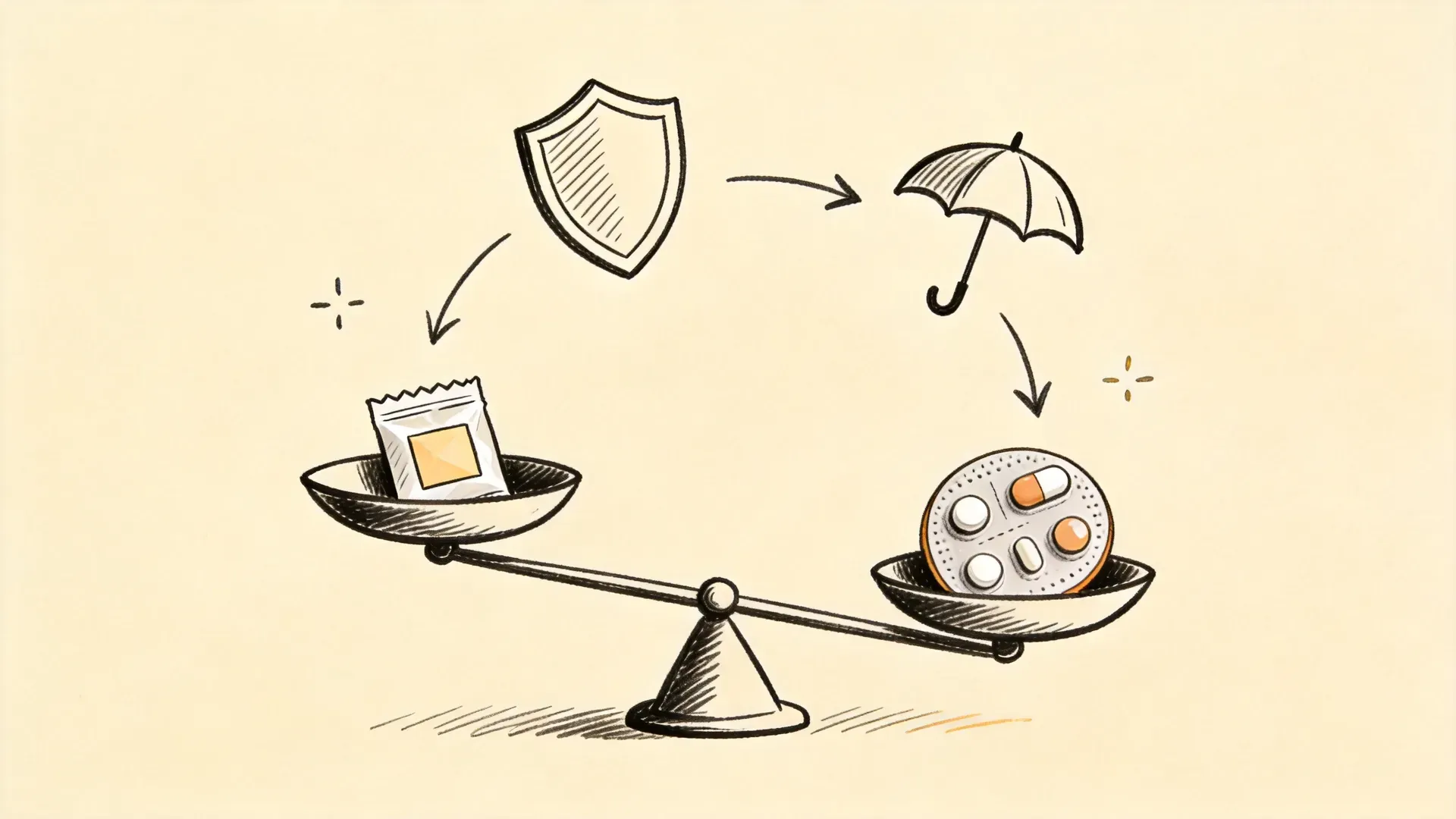
Condoms vs. Birth Control Pills: Which Protects You Better?
Condoms are 87% effective with typical use; the pill is 93% — but only condoms protect against STIs. Here's what the data says, and when to use both together.
It sounds like a simple question with a simple winner. It isn’t — because condoms and birth control pills don’t actually do the same job. One stops pregnancy more reliably than any in-the-moment habit most people can sustain. The other is the only mainstream contraceptive that also slows down infections. Asking “which protects you better” without saying from what is how people end up protected against the wrong thing.
So let’s do this properly. Below: the head-to-head pregnancy numbers, the STI numbers almost nobody puts side by side, the honest reasons real-world results lag the label, and the situations where the right answer is not either/or but both. (This is education, not medical advice — your health history belongs in a conversation with a clinician.)
Key Takeaways
- The pill wins on pregnancy prevention in real life. In a typical year, about 7 in 100 pill users get pregnant versus 13 in 100 condom users (CDC ↗, 2024). Used perfectly, they’re nearly tied: 99.7% vs. 98% effective.
- Only condoms protect against STIs. Consistent use cuts HIV transmission risk by roughly 80–95% and sharply reduces gonorrhea and chlamydia. The pill does nothing here.
- The real-world gap is about behavior, not products. Around half of pill users miss at least one pill a month, and a third have missed pills because they couldn’t get a refill in time.
- “Both” is the clinician-backed answer for combined risk. 58% of U.S. women who use multiple methods pair a condom with another method (Guttmacher Institute ↗, 2021).
The short answer: better at what?#
Here’s the whole article in one sentence: the pill protects you better against pregnancy, condoms protect you better against infection, and which one “wins” depends entirely on which risk you’re actually facing.
That’s not a cop-out — it’s the reframe most comparison pages skip. They rank the two methods on pregnancy alone, declare the pill the winner, and leave readers with the impression that birth control is a solved problem. Meanwhile, the only method that touches the STI side of the board got treated as a consolation prize.
A quick orientation before the details:
| Condoms (external) | Birth control pills | |
|---|---|---|
| Pregnancy, typical use | 87% effective | 93% effective |
| Pregnancy, perfect use | 98% effective | 99.7% effective |
| STI protection | Yes — the strongest of any contraceptive | None |
| Hormones | None | Yes (combined or progestin-only) |
| Prescription | No | Usually yes (one OTC exception) |
| Effort | Every single time, in the moment | Daily, at roughly the same time |
| Typical cost | A few dollars, often free at clinics | 20/month OTC |
Numbers from the CDC ↗ (2024); the rest of this article is the story behind them.
Pregnancy prevention: condoms vs. birth control pills, by the numbers#
The pill takes this round — but by less than the marketing suggests. With typical use, about 7 in 100 pill users get pregnant within the first year, compared to 13 in 100 condom users (CDC ↗, 2024). Flip to perfect use and the gap nearly vanishes: 0.3 in 100 versus 2 in 100.
Those two rows of numbers describe two different worlds. “Perfect use” is a lab condition — every pill at the same time daily, every condom on before any genital contact, every time. “Typical use” is what actually happens in the first year of real people using the method, mistakes included. Almost nobody lives in the perfect-use world, which is why the typical-use row deserves most of your attention.
Two things worth noticing in that chart. First, condoms have the widest typical-to-perfect gap of the four — an 11-point swing that lives entirely in how and whether they’re used. Second, the pill’s 7% typical-use failure rate is not the pill failing; it’s the daily routine failing, which brings us to the section competitors usually skip.
Verdict: the pill wins this category, 93% to 87% — with the asterisk that both numbers are behavior, not chemistry.
Why real life looks worse than the label#
The distance between “typical” and “perfect” is mostly missed pills and mistimed condoms — not defective products. That matters, because it means your real protection level is something you have more control over than the box suggests.
On the pill side, the adherence research is humbling. In the foundational U.S. studies, about half of pill users reported missing at least one pill per month, and roughly 22% missed two or more — findings that later adherence reviews keep confirming (Adherence to the oral contraceptive pill ↗, PMC review). A 2019 survey found 39% of millennials had forgotten their pill at least once in the past month (Caetano et al., The European Journal of Contraception & Reproductive Health Care ↗, 2019). And self-reports flatter reality: studies that tracked pill packs electronically found women actually missed an average of four or more pills per cycle — far more than they recalled. Sometimes the miss isn’t about memory at all: 33% of hormonal contraceptive users said they’d gone without because they couldn’t get their next supply in time — rising to 46% among the uninsured (KFF Women’s Health Survey ↗, 2022).
On the condom side, the errors are different but just as human: putting it on after contact has already started, not using one “just this once,” oil-based lubricant weakening latex, a wallet-stored condom cooked by body heat, or a size that slips. Latex itself almost never fails in the lab — the failures are situational.
The practical read: if you’re a flawless daily routine person, the pill performs near its 99.7% ceiling. If your life runs on travel, shift work, or chaos, assume the typical-use row — and price that in. This is the same honest-self-assessment logic that drives the bigger decision of choosing a birth control method that fits your life.
The STI question: where the pill offers zero protection#
Hormonal birth control provides no protection against sexually transmitted infections. None. Every hormone that prevents ovulation does exactly nothing to a virus or bacterium. If STI exposure is part of your risk picture, the pill alone leaves that entire side of the board empty.
Condoms, meanwhile, are the only contraceptive that plays on it — and their record is genuinely strong against some infections, partial against others. The distinction that matters is fluid-borne versus skin-to-skin.
Infections carried in genital fluids — HIV, gonorrhea, chlamydia, trichomoniasis — meet a latex barrier and mostly stop there. A landmark WHO evidence review of condom effectiveness put the risk reduction from consistent use at roughly 80–95% for HIV, 49–90% for gonorrhea, and 33–90% for chlamydia (Effectiveness of condoms in preventing sexually transmitted infections ↗, WHO/NIH review). These are older study periods, but they remain the consensus figures health agencies cite today — lab work confirms latex is impermeable to even the smallest viruses, so real-world failures trace back to inconsistent use, not material.
Infections that spread skin-to-skin are a different story. Herpes (HSV-2) risk drops only about 40% with condoms, because the virus can live on skin the condom doesn’t cover. HPV protection is real but limited for the same reason — condoms help, and vaccination does the heavy lifting. One material caveat: natural-membrane (“lambskin”) condoms prevent pregnancy but have pores too large to block viruses — for STI protection, it’s latex or synthetic only.
Two implications. First, “reduce” is not “eliminate” — condoms plus regular testing is the actual strategy, and how often you should get tested for STIs depends on your partners and practices, not a generic calendar. Second, remember that exposure routes differ: oral sex carries its own, smaller set of risks, covered in the STIs you can get from oral sex.
Verdict: condoms win this category by default — they’re the only entry on the board.
Side effects, cost, and access#
Condoms ask almost nothing of your body; the pill asks daily hormones — and in exchange does things condoms can’t. This round is about everything besides raw effectiveness.
The pill’s tradeoffs are real but usually manageable. Nausea, breast tenderness, spotting, and mood changes are common in the first two or three months and typically settle as the body adjusts. Combined pills also carry a small but serious blood-clot risk, which is why a history of clots, migraine with aura, or smoking after 35 usually points a clinician toward progestin-only or non-hormonal options. On the plus side, many people get lighter, more predictable periods, less cramping, and clearer skin — side benefits condoms will never offer.
Condoms have no systemic effects at all. The genuine issues are latex allergy (answered by polyisoprene or polyurethane versions), sensation complaints (answered by size and material variety), and the in-the-moment interruption some couples dislike. Internal condoms exist too, at about 79% typical-use effectiveness — lower than external ones, but they put the option in more hands.
On cost and access, the ground recently shifted. Condoms remain the cheapest contraception available — a few dollars a pack, free at many clinics and campus health centers. Most insurance plans cover prescription pills at 20 a month — no appointment, no prescription, no pharmacy-counter conversation required.
Verdict: condoms win on zero-hormone simplicity, the pill wins if you want cycle benefits and don’t mind a daily medication, and cost is effectively a tie.
Why “both” is often the real answer#
When both risks are in play — pregnancy and STIs — the evidence-backed answer is dual protection, and a growing number of people already use it. Between 2008 and 2015, the share of U.S. women using more than one contraceptive method at last sex rose from 14% to 18% (Guttmacher Institute ↗, 2021). Among those multiple-method users, 58% paired a condom with another method — most often the pill. And looking at pill users specifically, about 21.7% also used a condom the last time they had sex (NSFG data via Correlates of Dual-Method Contraceptive Use ↗, NIH).
The logic is additive, not redundant. The pill handles pregnancy at 93–99.7%; condoms handle the STI axis and backstop the pill on weeks when doses get missed, vomiting hits within a few hours of a dose, or an interacting medication (rifampin-class antibiotics, some anticonvulsants, St. John’s wort) quietly blunts absorption. Clinicians recommend exactly this layering for anyone with a new partner, non-monogamous arrangements, or unknown testing status — the situations where “we’re careful” is a hope rather than a data point.
How to choose: match the method to the risk#
Forget “best.” Pick the protection that matches the risk you actually face this month:
- Mutually monogamous, both tested, pregnancy is the only concern? The pill alone is a reasonable, evidence-backed choice — 93% typical-use effective, with condoms as a backup for missed-pill weeks.
- New partner, unknown status, or non-monogamy? Condoms are non-negotiable, whatever else you use. The pill can join for pregnancy insurance, but nothing substitutes for the barrier.
- Know you can’t do a daily pill? Own that. Condoms used consistently beat a pill taken sporadically — and if you want hands-off pregnancy protection, that’s a conversation about IUDs and implants, not a reason to white-knuckle a routine you’ll abandon.
- Want maximum protection on both axes? Pill plus condoms. You’d be in good, growing company.
One honest caveat: this article compares two methods, but they’re not the whole menu — long-acting options beat both on pregnancy prevention. The full decision walkthrough lives in how to choose a birth control method that fits your life, and the complete guide to sexual health zooms out to testing, checkups, and the rest of the picture.
Frequently asked questions#
Do I still need condoms if I’m on the pill?#
If STI exposure is possible, yes — the pill prevents pregnancy but does nothing against infections. In a mutually monogamous relationship where both partners have tested negative, many couples reasonably drop condoms; that decision should follow test results, not precede them.
Which is better at preventing pregnancy, condoms or the pill?#
The pill, in the real world: about 7 in 100 typical users get pregnant in the first year versus 13 in 100 for condoms (CDC ↗, 2024). With perfect use they’re nearly equal (99.7% vs. 98%), which tells you the gap is mostly about human consistency. And timing within the cycle doesn’t rescue a missed method — yes, you can get pregnant on your period.
Can you use condoms and the pill together?#
Yes, and clinicians encourage it when both pregnancy and STI risks apply. 58% of U.S. women who use multiple methods pair a condom with another method (Guttmacher Institute ↗, 2021). There’s no interaction or downside beyond cost and effort.
What if I miss a pill — do condoms still matter?#
That’s exactly when they matter most. Missed pills are the main reason real-world effectiveness sits at 93% instead of 99.7%. Follow your pack’s instructions and use condoms as backup for the window it specifies — for combined pills, usually until you’ve taken seven consecutive days of active pills again (progestin-only pills have stricter rules, so check your specific pack).
Do condoms protect against all STIs?#
No. They’re highly effective against fluid-borne infections — HIV, gonorrhea, chlamydia — but only partially reduce skin-to-skin infections like herpes (~40% risk reduction) and HPV, because uncovered skin can still transmit. Vaccination and regular testing fill the gaps; see how often to get tested.
The verdict#
| Category | Winner |
|---|---|
| Pregnancy prevention (typical use) | The pill — 93% vs. 87% |
| Pregnancy prevention (perfect use) | The pill, barely — 99.7% vs. 98% |
| STI protection | Condoms — the only one that offers any |
| Side-effect simplicity | Condoms — no hormones |
| Cycle benefits (periods, acne) | The pill |
| Cost & access | Tie — cheap condoms vs. 20 OTC pill |
| Both risks at once | Both together |
So: condoms or the pill? For pregnancy alone, the pill. For infections, condoms — by default, since the pill doesn’t compete there. For the very common situation of caring about both, the answer the data points to is the one nearly 1 in 5 U.S. women of reproductive age — and most clinicians — have already landed on: layer them.
The method that protects you best is the one matched to your actual risks and your actual routine. If the routine question is the sticking point, start with choosing a birth control method that fits your life — and if it’s been a while since your last screening, how often you should get tested for STIs is the natural next read.